Stern, Robert
1934 - 2018
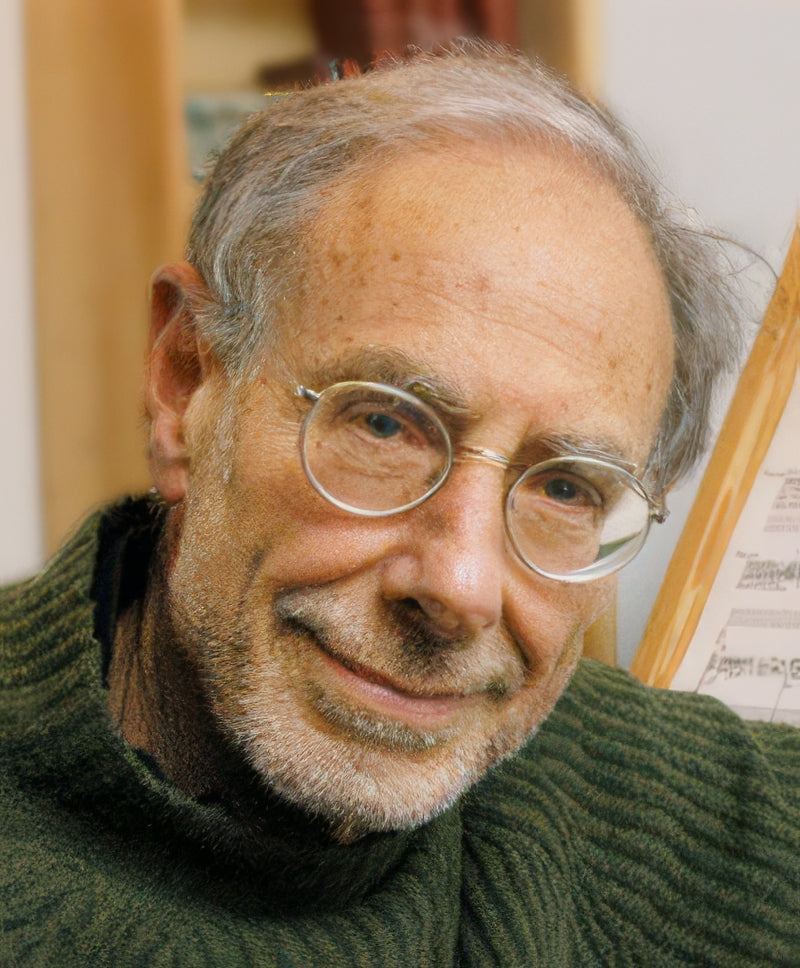
Robert Stern was born in Paterson, New Jersey, in 1934. He developed an early love of music when his mother brought him to classical music concerts, and his musical talent was recognized during his elementary school years.
He earned bachelor’s and master’s degrees from both the Eastman School of Music and the University of Rochester. After completing his studies, he entered the U.S. Army and was assigned to the award-winning Third Army Band as a music arranger. He especially enjoyed playing piano with his combo, the “Mood Masters,” at officers’ clubs and local bars.
Following his discharge from the Army, Stern enrolled at UCLA to study with composer Lukas Foss, whose music had deeply impressed him. Foss became a lasting mentor. Stern later returned to Eastman to complete his Ph.D. in composition. His teachers included Kent Kennan, Bernard Rogers, Louis Mennini, Lukas Foss, and Howard Hanson.
In 1964, Stern was recruited by department chair Philip Bezanson to join the faculty of the Department of Music and Dance at the University of Massachusetts Amherst. He taught composition and theory there until his retirement in 2002. Over nearly four decades, he delighted in composing for and collaborating with many close colleagues.
Stern’s music has been performed throughout the United States as well as in Europe, China, South America, Japan, and Israel by prominent ensembles and artists such as the Beaux Arts String Quartet, Collage, the Da Capo Chamber Players, the Contemporary Chamber Players at the University of Chicago (under Ralph Shapey), the Eastman Musica Nova, Yehudi Wyner, Joel Smirnoff, Gilbert Kalish, Marni Nixon, Jan Opalach, Joel Krosnick, and the Gregg Smith Singers.
Throughout his career, Stern received numerous honors, including grants from the National Endowment for the Arts, the Massachusetts Council on the Arts and Humanities, and the Martha Baird Rockefeller Fund. He was awarded fellowships from the MacDowell, Millay, and Yaddo Colonies, and received awards from ASCAP and the Premio Musicale Città di Trieste International Competition, where, in 1979, for his orchestral work Yam hamelakh.
He received commissions from the Library of Congress McKim Fund, the Mendelssohn Club of Philadelphia, the Manchester International Cello Festival, and the U.S. Holocaust Memorial Museum. His works have been recorded on several labels and published by G. Schirmer, Rinaldo Music Press, and Transcontinental Music. His music was featured in concert series such as Musica Viva in Tel Aviv, Lukas Foss’s Meet the Moderns, the Festival of American Music at Eastman, the Camden Festival in England, the Fromm Contemporary Music Series at Harvard, the Aspen Music Festival, and the Ravinia Festival.
Stern also embraced the emerging field of electronic music and served as a visiting professor at Hampshire College during its formative years. In 1990, he was honored with the Faculty Fellowship Award from UMass Amherst.
The 1962 publication of I Never Saw Another Butterfly—a collection of children’s poems and drawings from the Terezin ghetto—had a profound impact on Stern. He developed a deep interest in the artistic expression that emerged from the concentration camps, and in the power of creativity under extreme circumstances. After visiting Terezin and meeting some of the surviving authors, Stern devoted much of his compositional work to memorializing the Holocaust and its legacy. As the years passed and cries of “Never Again” seemed increasingly fragile, his work responded with clarity and conviction.
In the early 2000s, he completed the oratorio Shofar, in collaboration with Amherst writer Catherine Madsen, whose libretto he called “stirring and heartbreaking.” Shofar explores the relationship between God and humankind through the biblical experience at Sinai and the four shofar calls used during the Jewish Days of Awe. These calls—signifying wholeness, brokenness, devastation, and restoration—culminate in the oratorio’s powerful conclusion:
each craved a kinder lover,
we only have each other,
we make the world together,
there is no other labor.
Music at ACA
-
-
-
Robert Stern
Grant Us Peace....
Orchestra 2(2+picc)2(2+EH)2(2+bcl)2 - 4231 - timp - strings
$44.00 - $200.00🔉 -
-
-
-
-
-
-
Robert Stern
Prologue for Small Orchestra
Chamber Orchestra 1111 - 2110 - timp, pno - strings
$34.00 - $150.00🔉 -
-
-
-
-
-
Robert Stern
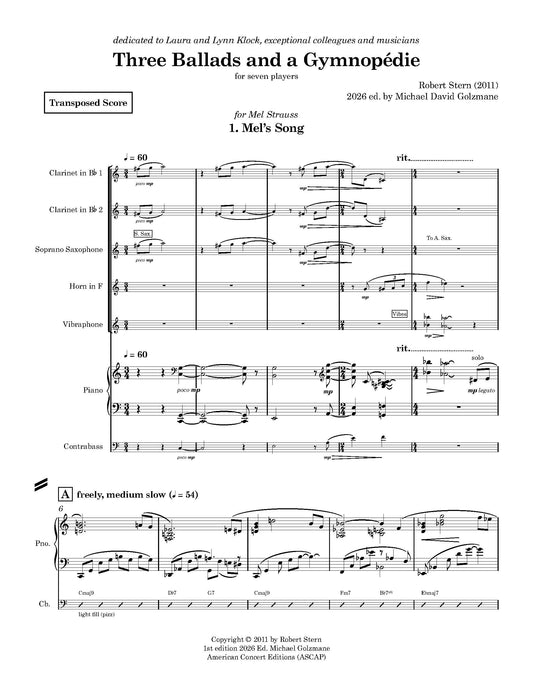
Three Ballads and a Gymnopédie
2 Clarinets, Soprano Saxophone (Doubling Alto), Horn, Percussion (Glockenspiel and Vibraphone), Piano, and Contrabass
$44.00 - $78.50 -
-
-