Three Hebrew Songs
Three Hebrew Songs
Soprano and Piano
Editor's Note:
Three Hebrew Songs was written for the soprano Paulina Stark (1936–2025) over a period of four years, between 1986 and 1990. Stark joined the faculty of the University of Massachusetts, Amherst, in 1985. These three pieces are not a song cycle in the traditional sense; rather, they are linked by their use of the Hebrew language and by their association with the same singer–pianist partnership.
Al Tifg’i Vi and Rad Halaila were the first songs written. Several years later, in 1990, Stern composed Numi, Numi. In 1992, Al Tifg’i Vi and Numi, Numi were published together by Transcontinental Music Publications under the title Two Hebrew Songs. Rad Halaila was not included in that edition.
Al Tifg’i Vi and Rad Halaila received their first documented New England performances on September 24, 1988, at the University of Massachusetts, Amherst, with Paulina Stark as soloist and pianist Nadine Shank (1954–2020). That same year, the two artists recorded the album American-Jewish Art Songs, which includes Stern’s Al Tifg’i Vi and Rad Halaila. The recording was originally released on Spectrum Records (SR-328) in 1988 and later reissued on Centaur Records (CRC2108), released July 3, 1992. It was recorded at Pratt Auditorium, Mount Holyoke College, South Hadley, Massachusetts.
Numi, Numi received its world premiere on March 17, 1991, at the 92nd Street Y in New York City, in a concert presented by the American Society for Jewish Music, again with Stark and Shank.
The three songs draw on texts from biblical scripture, modern Hebrew poetry, and twentieth-century Hebrew literature. In all three pieces, Stern’s music is entirely original.
During the 1990s, the three songs began to be performed together in the order presented in this volume. The present edition marks the first time all three works have appeared together in a single publication, and the first time the score for Rad Halaila has been published at all.
1. Al Tifg’i Vi
(text from the Book of Ruth 1:16)
The opening song sets Ruth’s declaration to her mother-in-law Naomi. In the Book of Ruth, Naomi, an Israelite living in Moab, prepares to return to Bethlehem after the deaths of her husband and sons. She urges her daughters-in-law to remain behind; one does, while Ruth responds with this statement of commitment and chooses to accompany her.
The musical material of this movement originates in Stern’s cantata A Rushing of New Waters (1986), written for women’s chorus, soprano solo, piano, narrator, and optional bells. There it appears as a series of recitative passages. Al Tifg’i Vi is a metricized version of that recitative material, reshaped into a full art song.
2. Rad Halaila
(text by Ya’akov Orland)
Ya’akov Orland (1914–2002) was a major figure in modern Hebrew poetry and song. His texts occupy a central place in twentieth-century Hebrew literary culture.
Rad Halaila is widely known through its familiar setting as a hora, a lively communal circle dance central to Israeli folk tradition, and is often regarded as the most famous Israeli dance song after Hava Nagila. Stern does not quote the familiar melody, but instead creates an entirely original setting.
Around the same period that Rad Halaila was composed, Stern also wrote My Daughter the Cypress, a work for women’s chorus, solo viola, and piano. The opening harmonic gesture of Rad Halaila and My Daughter the Cypress is identical. The editor does not know which of the two works was composed first.
My Daughter the Cypress received its premiere in 1987. Rad Halaila has never before been published.
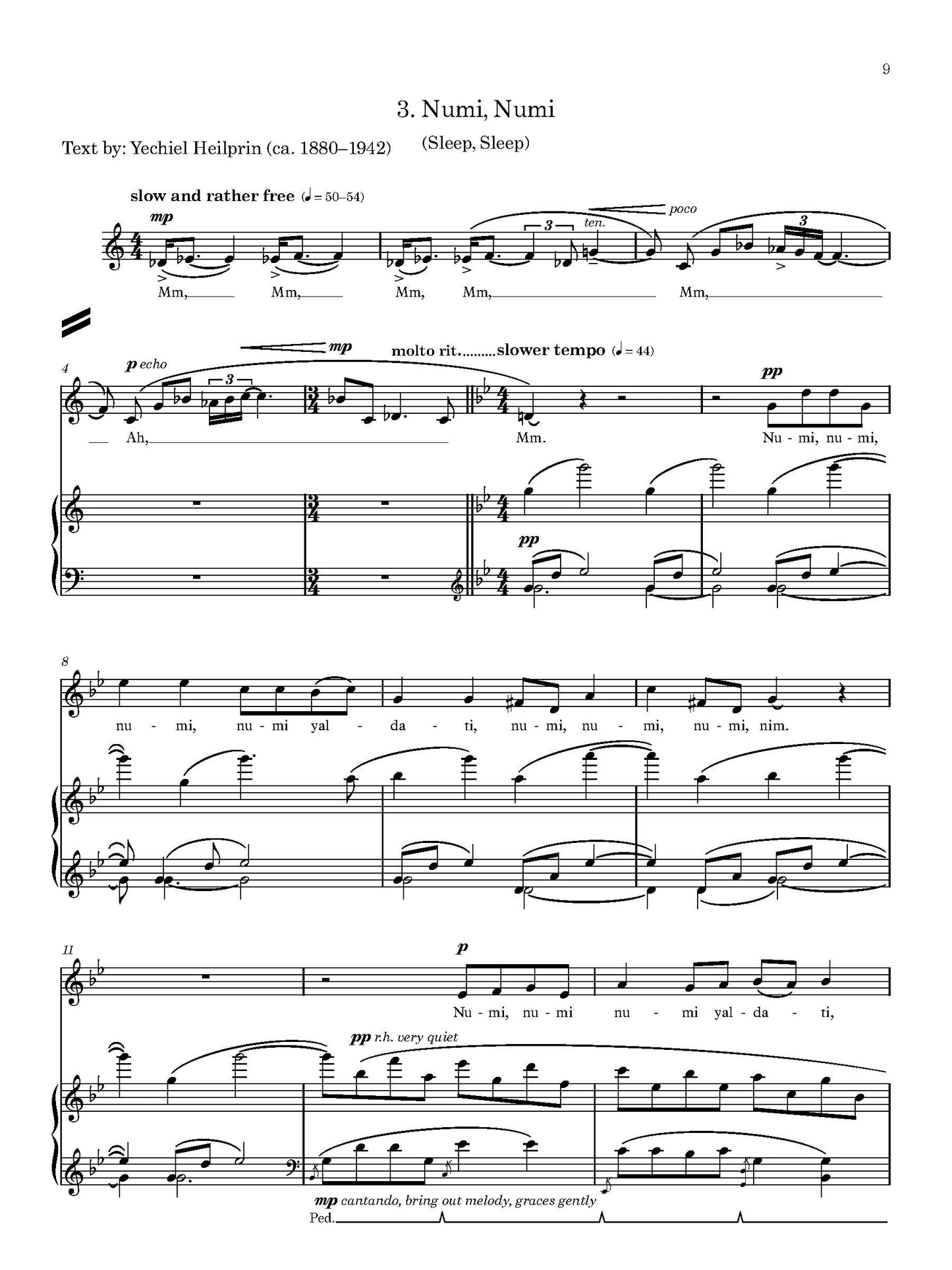
3. Numi, Numi
(text by Yechiel Heilprin)
Yechiel Heilprin (ca. 1880–1942) was a Hebrew writer and educator. Numi, Numi is a short lullaby text that became widely known. Stern’s setting originated as a personal gift: the melody was composed for the newborn niece of Paulina Stark, Rebecca González-Kreisberg. In the poem, the words yaldati and k’tanati are used, both explicitly feminine —yaldati meaning “my little daughter” or “my baby girl,” and k’tanati meaning “my female child” or “my little one.”
Stern embedded the child’s name, Rebecca, into the musical fabric of the piece, using its letters to generate the principal motive: R–E–B–E–C–C–A (Notes: E–B–B–E–C–C–A–A).
Edited or Arranged by: Michael Golzmane
Movements: Al Tifg'i Vi Rad Halaila Numi, Numi
Authored (or revised): 1990
Published: 2026
Text source: Book of Ruth 1:16, Ya’akov Orland, and Yechiel Heilprin
Duration (minutes): 7
Book format: Score
SKU
ACA-STER-012Subtotal
$20.00Couldn't load pickup availability