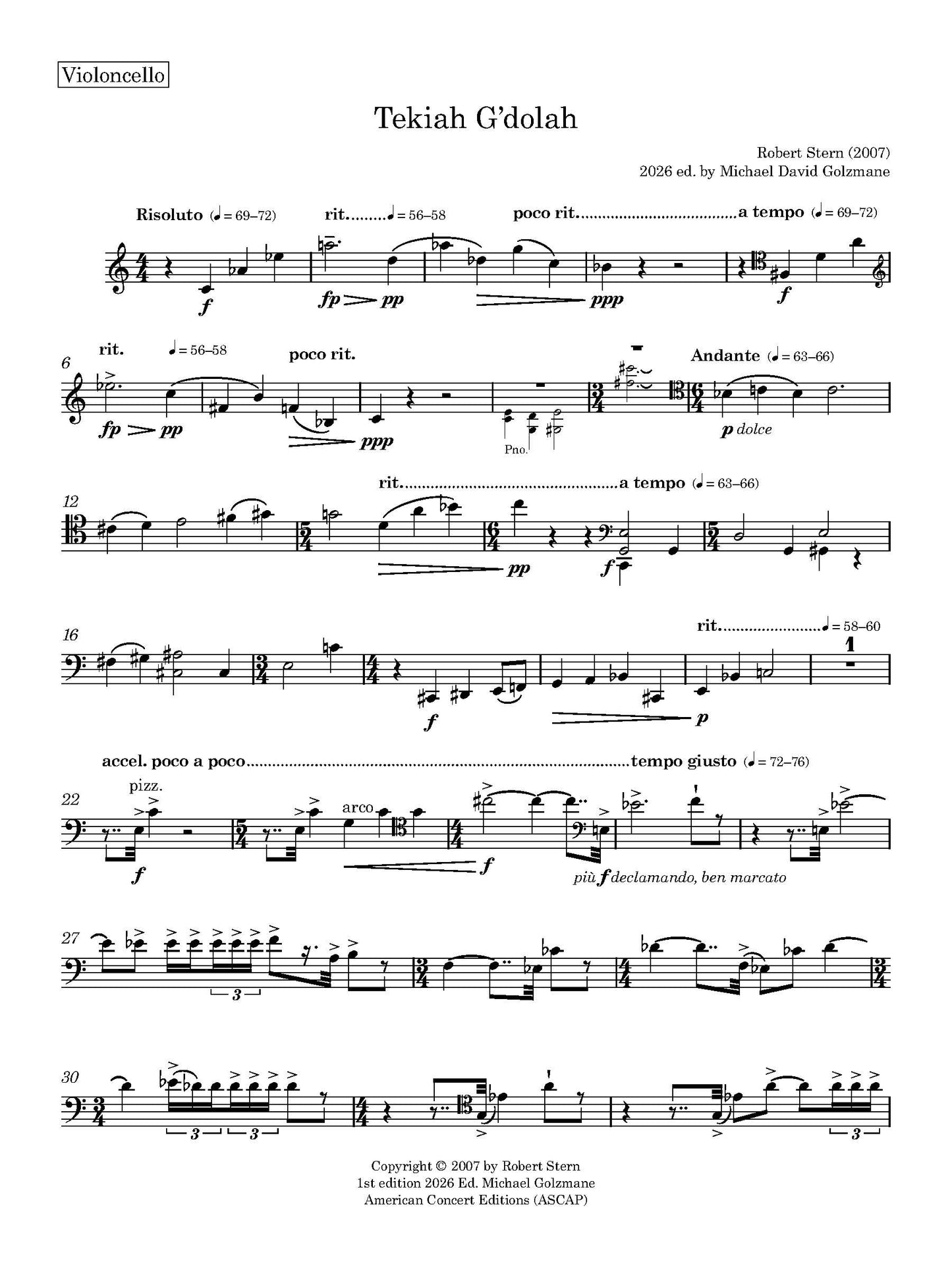
Tekiah G'dolah
Tekiah G'dolah
Cello and Piano
Editor's Note:
In 2006, Robert Stern completed Shofar, a large-scale oratorio that stands among the central spiritual works of his career. Rooted in Jewish liturgy, scripture, and history, it follows the arc embodied in the four traditional shofar calls—from wholeness, through rupture and shattering, toward renewal. For Stern, these calls were never merely ceremonial; they expressed something fundamental about human life: our breaking, and our persistent desire to become whole again.
From that expansive choral and orchestral work emerged Tekiah G’dolah (2007), an intimate companion piece for solo cello and piano. Stern wrote it for cellist Joel Krosnick (1941–2025) and pianist Gilbert Kalish, longtime colleagues and collaborators. Stern and Krosnick first met when they were both professors of music at the University of Massachusetts at Amherst in the late 1960s. Their first collaboration was Stern’s Terezín song cycle for soprano, cello, and piano (NWCRL264, originally released on the Composers Recordings, Inc. label and now distributed by New World Records).
Tekiah G’dolah is not the only chamber work to grow out of Shofar. An earlier offshoot is Recitative (Yom Teruah), composed in 2001 for solo cello, then revised and transcribed for solo viola in 2006. Both versions are published by the American Composers Alliance. Like Tekiah G’dolah, Recitative (Yom Teruah) draws directly on thematic material from Shofar.
The existence of Tekiah G’dolah only came to light in 2024 during the editor's research connected with Shofar. The score does not appear in the collected scores of Robert Stern donated by his wife, Judy Glaser, to the UMass Special Collections and University Archives (SCUA). While investigating who had originally engraved the first performance edition of Shofar—as Stern himself did not use notation software—Judy Glaser connected the editor with David Hodgkins, a former UMass student, longtime friend of Stern, and the conductor of Shofar’s premiere and first recording. Hodgkins identified Jerry Noble as the engraver of Shofar. When contacted, Noble reported that he retained his engraving files for several Stern works, including Tekiah G’dolah, a piece then unknown to the editor. Noble provided the complete engraving file, which constitutes the only known surviving score of the work.
The present edition is based on that file. Certain issues of spacing, alignment, and notation consistency required editorial judgment in the absence of an autograph or other source. These decisions have been made conservatively, with the aim of preserving Stern’s musical intentions as accurately as possible.
The title refers to the final and longest shofar blast of the High Holy Days—a sustained sound associated with return and renewal. In the oratorio, this moment marks reconciliation and the affirmation that “we make the world together; there is no other labor.” In the chamber work, Stern reshapes that idea through a close musical exchange, drawing themes and harmonies from Shofar into a focused dialogue between cello and piano.
Stern’s musical language here remains unmistakably his own: fundamentally tonal, deeply lyrical, yet capable of stark dissonance when the emotional terrain demands it. The cello sings with human vulnerability—at times questioning, at times radiant—while the piano frames and challenges it, echoing the covenantal dialogue that lies at the heart of Shofar.
Tekiah G’dolah is not a reduction of the oratorio but a transfiguration of it. It offers a meditation rather than a narrative, a spiritual afterimage of Shofar’s journey, distilled to its essence. In this chamber form, Stern invites us to experience the shofar’s final call not as public proclamation, but as inward resonance: a sustained arc of sound in which the cello and piano unfold a single, longbreathed gesture of return—music that carries the weight of wholeness in its most intimate form.
Tekiah G’dolah was completed in June 2007 in Amherst, MA, and was first performed on December 6, 2007, in Paul Hall at The Juilliard School, by Joel Krosnick (cello) and Gilbert Kalish (piano), as part of a Juilliard faculty recital. A recording of the premier performance is archived in the Juilliard library.
Edited or Arranged by: Michael Golzmane
Authored (or revised): 2007
Published: 2026
Duration (minutes): 11
First performance: December 6, 2007, in Paul Hall at The Juilliard School - Joel Krosnick, cello; Gilbert Kalish, piano
Book format: Score and Part
SKU
ACA-STER-011Subtotal
$30.00Couldn't load pickup availability