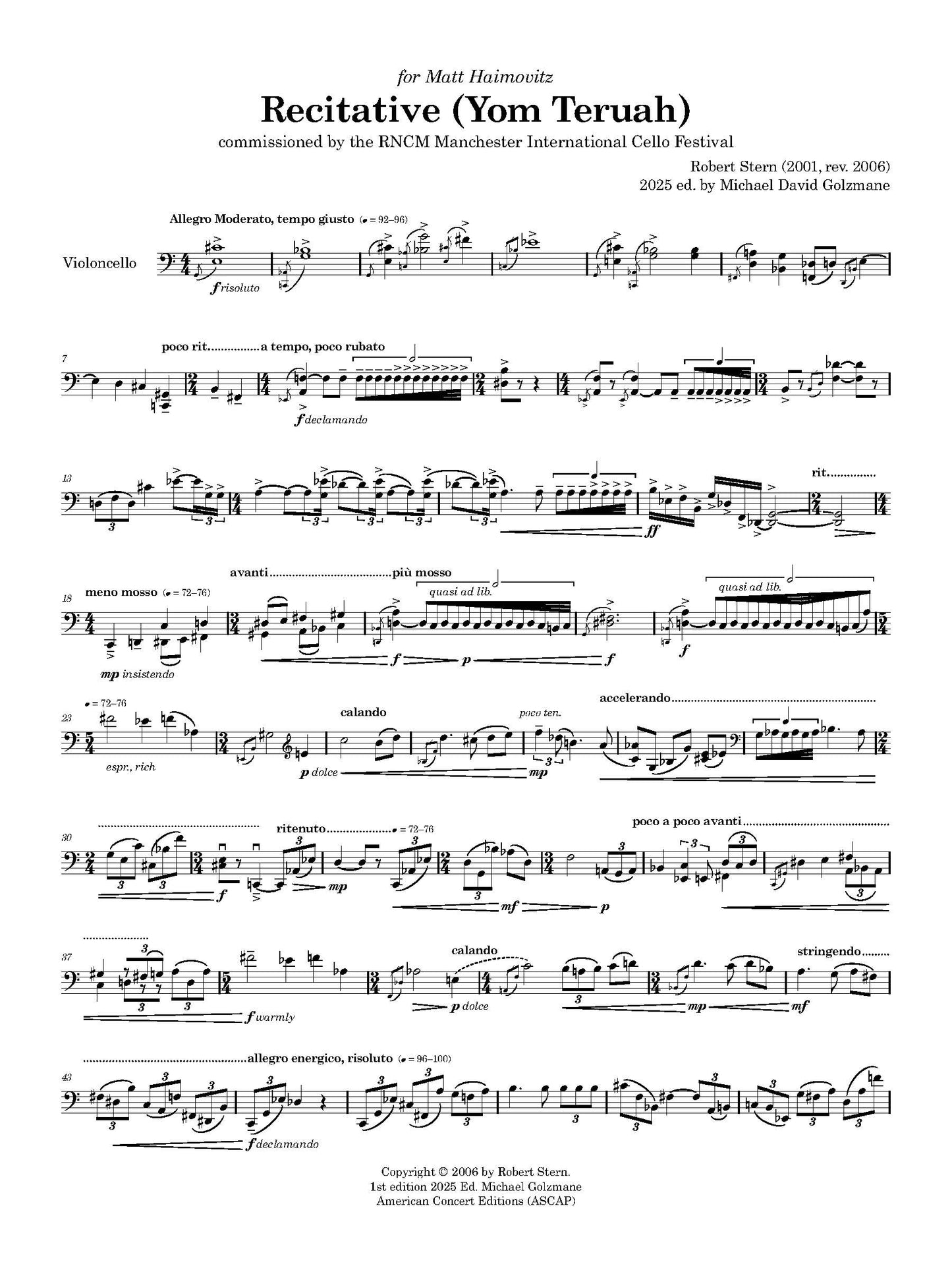
Recitative (Yom Teruah) for Cello
Recitative (Yom Teruah) for Cello
Cello
Editor's Note:
Robert Stern’s Recitative (Yom Teruah) originated in 2001 at the request of cellist Matt Haimovitz, then professor of cello at the University of Massachusetts/Amherst. Haimovitz had asked Stern—himself also on the faculty there—to compose a short solo work for the RNCM Manchester International Cello Festival.
Written amid the composer’s concurrent immersion in his large-scale oratorio Shofar, the Recitative became an offshoot of that larger spiritual landscape, drawing directly on the oratorio’s motivic and harmonic material.
The title, Yom Teruah (“Day of the Blowing of the Shofar”), refers to Rosh Hashanah, the Jewish New Year. The piece is both invocation and reflection—a ritual fragment in sound. Its rhetoric echoes the prophetic style of a liturgical recitative: declamatory, sounding often unmetered, by turns commanding and imploring.
Five years after its premiere, in 2006, Stern revisited the work, creating a new version for viola for the distinguished violist Matthew Hunter, a native of Amherst, MA who went on to become the first American-born string player in the Berlin Philharmonic Orchestra.
Stern’s reworking was far more than a transposition: it was a recomposition; changing notes, harmonies, and phrase lengths; tightening seams, and distilling the work's dramatic landscape more clearly than before; and even writing an entirely new ending.
As critic Clifton Noble Jr. noted in his review for The Republican, “Stern reworked the solo cello piece significantly with the brighter color of the viola and Hunter’s unique sensibilities in mind.” The viola version introduced new expressive markings, dynamic shading, and changes in phrasing and rhythm, while retaining the original’s intense lyricism and ritual gravity.
This 2025 edition represents the first systematic collation of all extant source materials: the engraved 2001 cello part; the composer’s annotated working copy, containing numerous handwritten red-pen revisions; original sketches for both the cello and viola versions; and several unique copies of the 2006 viola manuscript, reflecting Stern’s last authorized rethinking of the work.
According to the editor’s account:
“In these 2025 editions, I've amalgamated Stern's sketches, original cello score, hand-written revisions, and elements found in all available sources.
I used as much of the terminology and articulations that are in the original cello part, but which the composer didn’t necessarily transfer to the revised cello or viola parts. I believe those were omissions, not intentional edits. The nuances of all extant versions of the piece are additive, contributing to what I believe is the closest rendering of the composer's intentions as possible, without contradiction.
So this new edition merges markings from all sources—composer’s annotations, the engraved cello score, and the later viola manuscript—to create two parallel editions: one for cello, one for viola, now virtually identical except for the octave of transposition.
It is my belief that this is ultimately what Stern intended.”
In discussion with Stern's long-term colleague, the editor learned that the feather-beamed passages, often marked quasi ad libitum, were not intended necessarily as precisely measured numbers of notes as written, but as gestural improvisations—spontaneous outpourings modeled on the shofar’s sound patterns. The performer may feel free to approximate the number of notes, to help co-create the most effective-sounding gesture.
Also, there was an inconsistency in the use of slurs between the various past editions and manuscript copies. The editor has done his best to show what he believes to be the final and best intentions of the composer, but based on the inconsistency, the performer should feel free to use some personal liberty.
And finally, as Noble observed after the Mohawk Trail performance of the viola version:
“Hunter ripped every ounce of intensity and expressive power from Stern’s rhapsodic miniature. Angular outbursts, stylized representations of the ram’s horn’s stirring blast, were linked by shimmering strands of Stern’s characteristic impassioned lyricism.”
Edited or Arranged by: Michael Golzmane
Authored (or revised): 2001
Published: 2025
Duration (minutes): 4
First performance: Matt Haimovitz, cello — May 4, 2001, Manchester, UK
Book format: Score
SKU
ACA-STER-006Subtotal
$15.00Couldn't load pickup availability