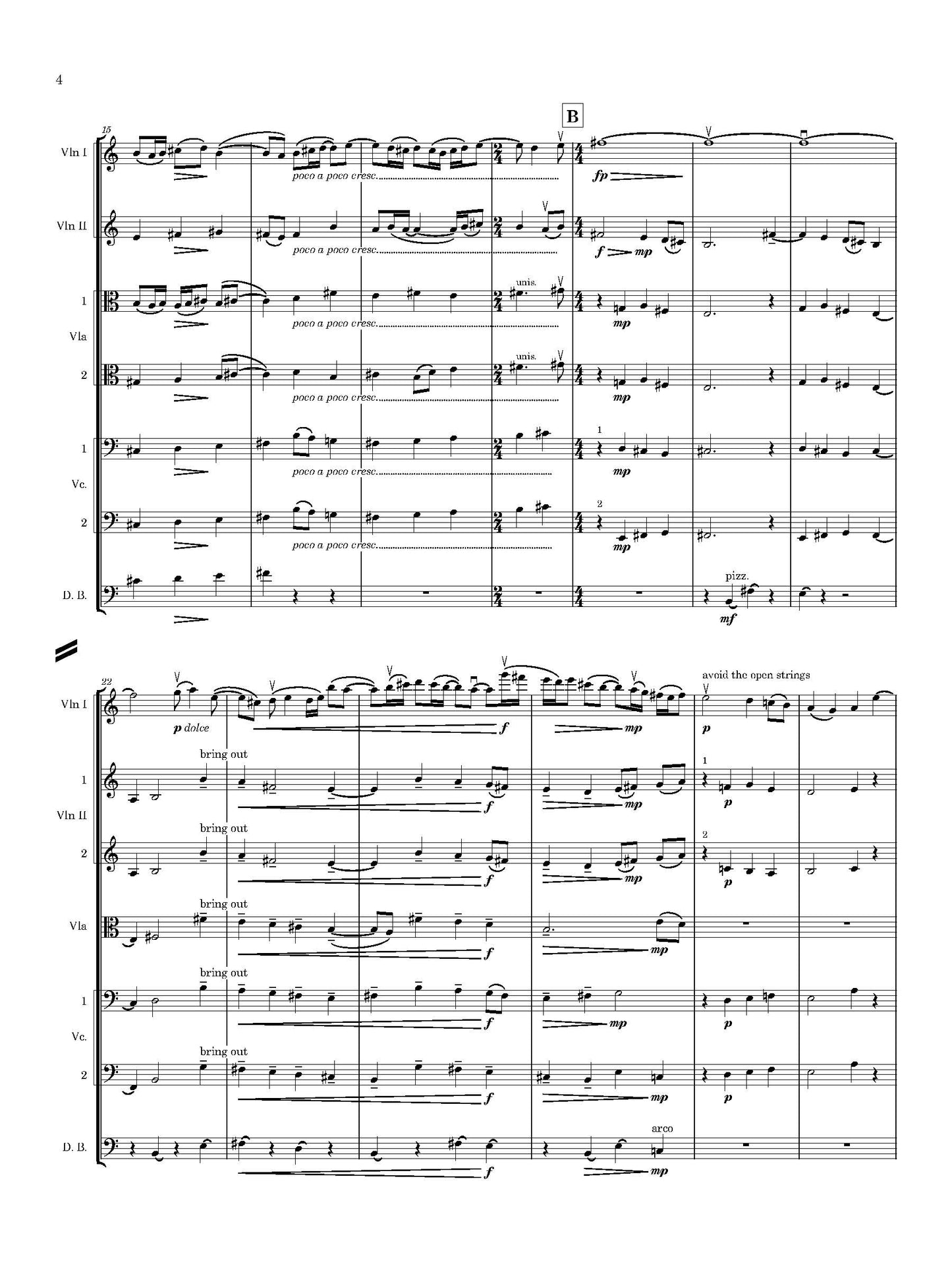
In Memoriam Abraham
In Memoriam Abraham
String Orchestra
Editor's Note:
In Memoriam Abraham was composed in 1955 by Robert Stern while he was a student at the Eastman School of Music, studying composition with Bernard Rogers. The work is an elegy for string orchestra written in honor of the composer’s maternal grandfather, whose life and character left a lasting impression on him. Stern’s music from this period reveals an early affinity for seamless, lyrical line and clear contrapuntal texture—qualities that define the quiet eloquence of this work.
The piece received the Edward B. Benjamin Prize in 1956, a $500 award established through the philanthropy of Edward B. Benjamin, a Southern industrialist who believed that contemporary music had become too loud and agitated. Benjamin founded the prize in 1953 in collaboration with Eastman director Howard Hanson to encourage the composition of orchestral music that was “quiet” or “tranquil” in character. The winning works were often performed at Eastman’s Festival of American Music and occasionally recorded as part of Hanson’s Music for Quiet Listening series.
As part of the award’s recognition, In Memoriam Abraham was conducted by Howard Hanson with the Eastman- Rochester Symphony Orchestra and subsequently recorded. The work went on to receive performances by several orchestras throughout the United States and abroad. Its European premiere took place in August 1961, when Paul Freeman conducted it with the Aalborg By-Orkester in Aalborg, Denmark.
In Memoriam Abraham continued to appear on concert programs in later decades, including performances by the Five College Orchestra (Massachusetts, USA) and the Williams College Choral Society Orchestra (1993) under E. Wayne Abercrombie. The work was also excerpted in the 1988 PBS documentary JFK: A Time Remembered, bringing its reflective tone to a national audience.
Lasting about six minutes, In Memoriam Abraham unfolds as a continuous elegy whose quiet lyricism and seamless string textures communicate both restraint and deep emotional resonance. Its timeless, meditative character exemplifies the ideals behind the Benjamin Prize—music that “charms and soothes” rather than overwhelms, expressing the power of simplicity and repose.
This work remains one of Stern's most performed and beloved works.
Edited or Arranged by: Michael Golzmane
Authored (or revised): 1955
Published: 2025
Duration (minutes): 6
First performance: 1956 at the University of Redlands School of Music, California - Redlands University-Community Orchestra with Morrie Brenner, conductor
SKU
ACA-STER-005sSubtotal
$16.00Couldn't load pickup availability