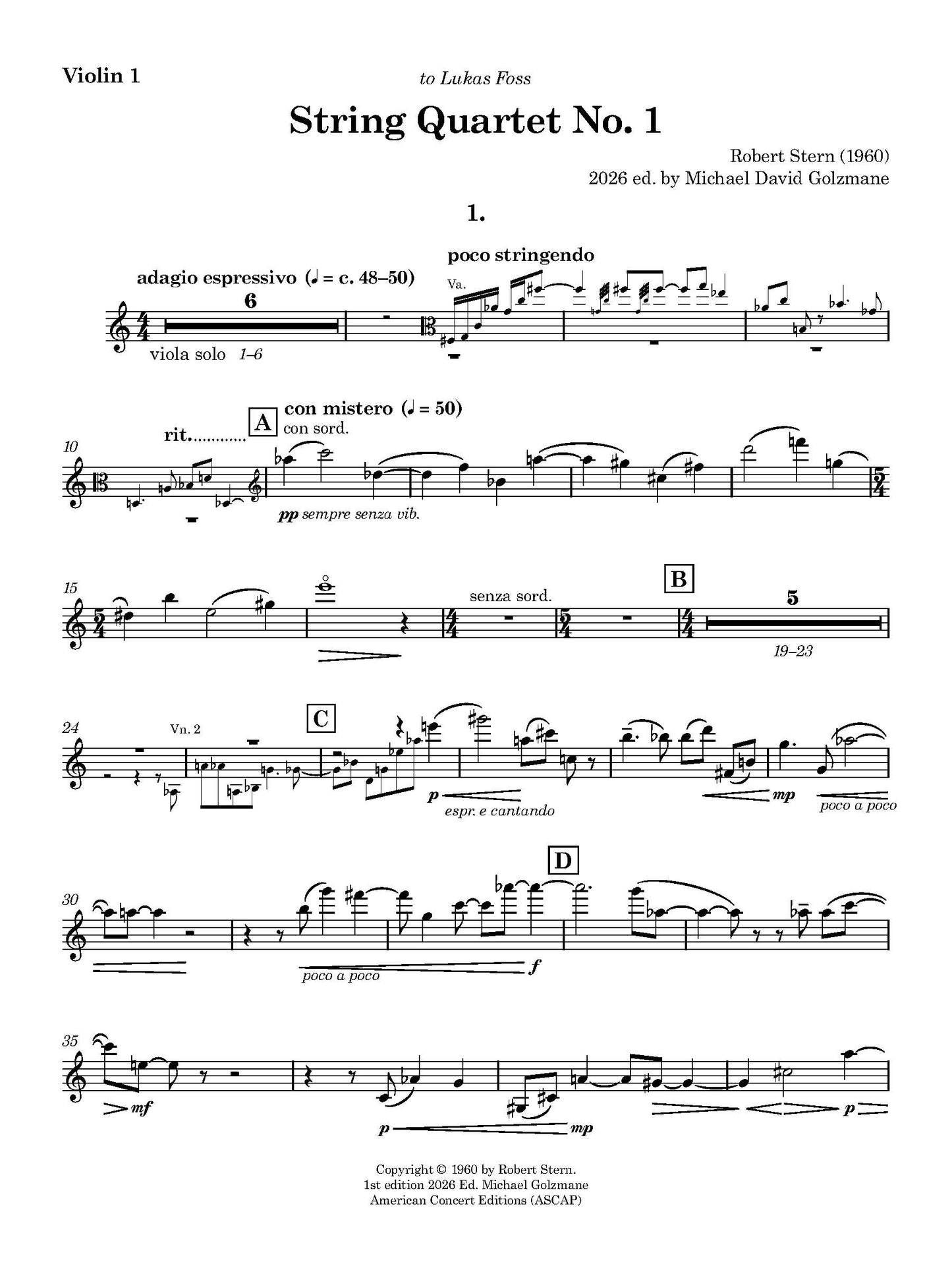
String Quartet No. 1
String Quartet No. 1
String Quartet
Editor's Note:
Robert Stern’s String Quartet No. 1 was composed between 1958 and 1960 and is dedicated to Lukas Foss, who served as Stern’s mentor during his studies at UCLA in the late 1950s. Stern had earned his bachelor’s degree in music—composition and piano—from the College of Arts and Science of the University of Rochester in 1955, and his master’s in composition and piano from the Eastman School of Music in 1956. In the interim before his doctorate, he fulfilled his Army service and then moved to Los Angeles for approximately two years to study with Foss, afterward returning to Rochester to complete his Ph.D. in composition at the Eastman School of Music under Bernard Rogers in 1962. The quartet, written during this interim period, is in many respects a product of both relationships. Stern’s connection with Foss developed into a lifelong one, with Foss offering continued encouragement and support throughout Stern’s career.
String Quartet No. 1 is the only string quartet Stern ever wrote.
The quartet received its premiere on May 2, 1960, at Kilbourn Hall at the Eastman School of Music in Rochester, New York. The first performance was given by Richard Kilmer and Dorothy Kaplan, violins; John Hamilton, viola; and Donna Magendanz, cello; and was coached by John Celentano. A recording of that premiere performance exists in the Sibley Music Library at Eastman. The premiere presented the original version of the work, the score of which has since been lost. The present edition represents a later revision by the composer—substantially the same in structure and content, but with certain seams tightened and a revised ending to the first movement. The premiere program listed the movements as Adagio, Semplice, and Introduzione—Allegro giusto; the revised edition retitles them Adagio espressivo, Semplice, and Agitato—Allegro giusto.
The work soon entered wider circulation. It was performed in 1962 at the Festival of American Music in Rochester. In 1964 it received a special citation in the Spoleto Festival-Competition for the Creative Arts—the jury included Samuel Barber, Gian-Carlo Menotti, Walter Piston, Gardner Read, and Charles Wadsworth—and was selected for performance at the Festival of Two Worlds in Spoleto, Italy, where it was played by the Beaux-Arts String Quartet, then quartet-in-residence at the festival.
On March 27, 1965, the quartet was selected for the New York City Composers' Forum at the Donnell Library Auditorium, moderated by Gene Bruck. That concert was devoted equally to the music of Robert Stern and Charles Dodge and concluded with a public question-and-answer session with the composers. Stern's quartet was performed by the Kohon String Quartet—Harold Kohon and Andrew Svilokos, violins; Eugenie Dengel, viola; and Leonard Stehn, cello—and appeared alongside two other Stern works: Playground, a divertimento for flute, contrabass, and percussion, and Three Songs, for soprano and piano—settings of texts by unidentified Jewish prisoners in the Nazi death camps—performed by Dorothy Ornest with the composer at the piano. The Kohon Quartet repeated the work the following month in Yonkers, New York, on April 23, 1965, on a program with quartets by Mozart and Smetana.
Both Playground and Three Songs are published by the American Composers Alliance.
The Beaux-Arts String Quartet (Charles Libove and Stephen Clapp, violins; John Graham, viola; Bruce Rogers, cello) continued to champion the work after Spoleto. Around this time the ensemble won the $20,000 Walter W. Naumburg Foundation Award and was hailed by the New York Times critic Harold Schonberg as "one of the most polished string quartets before the public." They programmed the quartet on their concert series, performing it at the University of Massachusetts on December 7, 1966, and at SUNY Fredonia on March 7, 1967. During this period the quartet appeared on programs alongside works by Haydn, Mozart, Mendelssohn, Smetana, Copland, and Beethoven.
On July 23, 1969, the work was performed by the Hollander String Quartet—Francine Nadeau Walsh and Thomas Buffum, violins; Denyse Nadeau Buffum, viola; and Richard Walsh, cello—at Mahar Auditorium during their summer residency at the University of Massachusetts, Amherst, on a program with Mozart and Glazunov.
The quartet continued to be performed in later decades. In the spring of 1983 it received two performances as part of the University of Massachusetts' American Music Festival III, both given by the same players: Julian Olevsky and Linda Laderach, violins (Laderach appearing as a guest artist from Mount Holyoke College); Carol Hutter, viola; and Leopold Teraspulsky, cello. The first, on April 12 at Bezanson Recital Hall in Amherst, prompted the composer to write to his son Aaron Michael on his copy of the program: "Dear Aaron, it went very well. After 23 years, I still like the work. Love, Dad."The work was repeated on April 24 at Jordan Hall at the New England Conservatory in Boston, after which Stern wrote to Aaron again: "Dear Aaron, it was a 'near-perfect' performance. Jordan Hall sound is luxurious—great for strings. Attendance poor; lousy night, rain! rain! Had a great dinner at Joyce Chen in Cambridge. Love, Dad."
After the composer's death, the score of String Quartet No. 1 was believed to be lost, as no copy was found among Stern's manuscripts. The present editor was able to locate what appears to be the only extant copy in the New York Public Library, with crucial assistance from David Peter Coppen, Special Collections Librarian and Archivist at the Sibley Music Library, Eastman School of Music, who used his specialized resources to trace the work's whereabouts. Within a day of its identification, an employee of the New York Public Library scanned the score and provided a digital copy. That single source forms the sole basis for this new edition.
The quartet is in three movements: Adagio espressivo, Semplice, and Agitato—Allegro giusto.
In her program note for the 1983 American Music Festival III at the University of Massachusetts, Miriam Whaples—professor of music history there throughout Stern's years on the faculty—described the work as follows. The first two movements are very brief. The Adagio espressivo opens with a viola solo characterized by wide, melodically dissonant intervals; this material is taken up contrapuntally by the other three instruments, reaches a climax, and dies out quickly. The second movement has the character of a siciliano: an opening duet for viola and cello is answered by a duet in the two violins, and the rest of the movement is marked by a rising whole-tone scale, played three times by the cello. The third movement is prefaced by a large tripartite introduction in which an agitato unison passage frames an elaborate cadenza for the cello. The movement proper is a fugue that returns to the wide, angular intervals of the first movement and is interrupted at one point by the agitato music of the introduction. It ends brilliantly, with a coda marked presto assai.
New engraved July 2026 edition from 1960 original.
Edited or Arranged by: Michael Golzmane
Movements: I. Adagio espressivo II. Semplice III. Agitato—Allegro giusto.
Authored (or revised): 1960
Published: 2026
Duration (minutes): 14
First performance: May 2, 1960, at Kilbourn Hall at the Eastman School of Music in Rochester, New York by Richard Kilmer and Dorothy Kaplan, violins; John Hamilton, viola; and Donna Magendanz, cello
Book format: String + 4 Parts
SKU
ACA-STER-017Subtotal
$49.00Couldn't load pickup availability