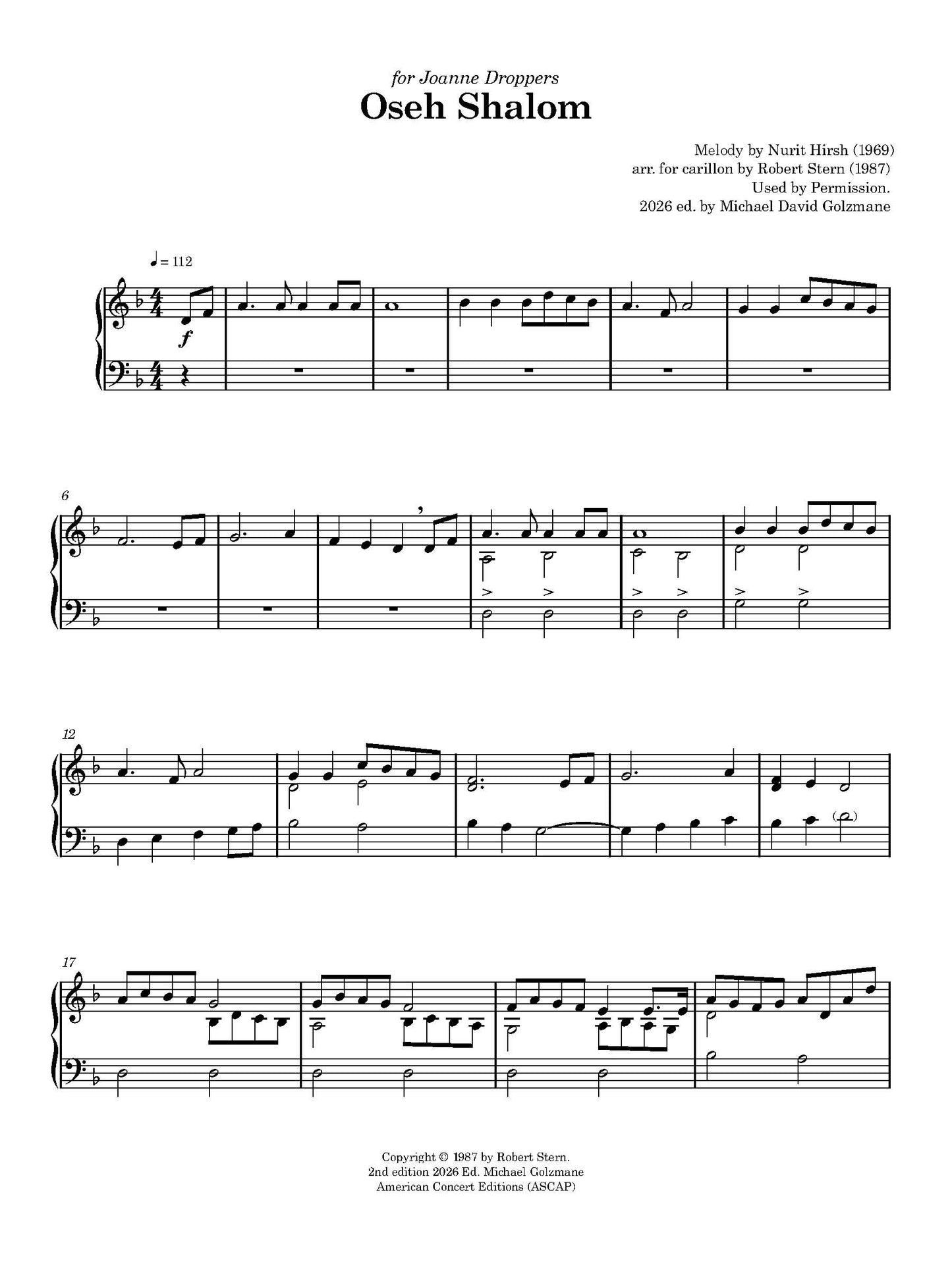
Oseh Shalom for Carillon
Oseh Shalom for Carillon
Carillon
Editor's Note:
The melody known as Oseh Shalom — its words drawn from the closing of the Kaddish, "May the One who makes peace in the heavens let peace descend on us, on all Israel, and on all the world" — was composed by the Israeli songwriter Nurit Hirsh in 1969 and has since become one of the most beloved tunes in modern Jewish worship. Robert Stern, for nearly four decades a professor of composition at the University of Massachusetts Amherst, returned to it three times across his career. This setting, made in 1987, is his most compact: a straightforward, warmly voiced harmonization of the tune, graced with gentle counterpoint, that unfolds over just two pages in two or three unhurried minutes.
Stern wrote it for solo carillon and dedicated it to Joanne Droppers (1932–2018), the carillonneur of Alfred University from 1977 to 1994 — a Cornell-trained musician who toured North America and arranged a great deal of music for the bells, from Bach to "Tubular Bells." The piece was published that same year in Carillon News, the journal of the Guild of Carillonneurs in North America, in its Spring 1987 issue. In his note to the score, Stern observed that while the arrangement "may be played any time," its most fitting hour is the Sabbath — "from Friday evening at sunset until Saturday at sunset" — letting the bells carry a prayer for peace out over the surrounding air.
The carillon Oseh Shalom is the briefest of Stern's three treatments of Hirsh's melody. The heart of the group is the expansive Fantasy on Oseh Shalom (1979) for violin and piano, written for the composer's son, Aaron Michael, on the occasion of his bar mitzvah; Stern later recast that work for solo organ as Rhapsody on Peace: Prelude on "Oseh Shalom" (1995), dedicated to Samuel Adler. Where those two are searching and elaborate, the carillon setting offers the tune plainly and radiantly, as a bell-song of peace.
Performance history: the only performance presently known was given on March 10, 1996, at the Crystal Cathedral in Garden Grove, California, where carillonneur James R. Lawson played it on the Arvella Schuller Carillon as part of a noontime program — the third of a set titled "Songs from Israel."
Nurit Hirsh (b. 1942, Tel Aviv) is one of Israel's most prolific and beloved composers. Trained as a pianist at the Academy of Music in Tel Aviv, she went on to study composition, orchestration, and conducting, and further pursued film and electronic music at UCLA. Over a career spanning more than four decades, she composed well over a thousand Hebrew songs—many with lyricist Ehud Manor—along with scores for some fourteen Israeli films and numerous stage musicals. Her best-known works include "Bashana Haba'ah" ("Next Year"), the widely sung liturgical setting "Oseh Shalom," and "A-Ba-Ni-Bi," which she conducted to victory as Israel's winning entry at the 1978 Eurovision Song Contest. Her honors include the ACUM lifetime achievement award (2001) and the Israel Prize (2016), Israel's highest civilian distinction. Both a composer and conductor, Hirsh helped shape the sound of modern Israeli song.
New 2026 2nd edition from original 1987 arrangement courtesy of Michael Golzmane.
Edited or Arranged by: Robert Stern
Authored (or revised): 1987
Published: 2026
Duration (minutes): 2
First performance: March 10, 1996, at the Crystal Cathedral in Garden Grove, California by James R. Lawson
Book format: Score
SKU
ACA-STER-018Subtotal
$13.50Couldn't load pickup availability