American Patriotic Songs Arranged for Guitar
American Patriotic Songs Arranged for Guitar
Guitar
Arranger's Note:
The arrangements in this collection are recorded by Aaron Larget-Caplan on his album Guitar America 250 (Navona Records), issued in March 2026 to commemorate the 250th anniversary of the USA Declaration of Independence.
America, The Beautiful
Composed in 1882 by Samuel A. Ward. Katharine Lee Bates wrote a poem titled “America” in 1895 inspired by her trip to Colorado. These became the lyrics to the song which was first published in 1910.
The arrangement begins with the chorus in harmonics as introduction. For the first verse, the melody is in the top voice and in the bottom voice for the second verse. One can play introduction with natural notes as found in measures 28-32.
Battle Hymn of the Republic
Written in 1861 by abolitionist Julia Ward Howe with the melody based on ‘John Brown’s Body’ written by Wiliam Steffe. It was an immensely popular song during the American Civil War and remains so today, linking the Union’s anti-slavery cause with God’s vengeance.
The arrangement begins with a snare drum percussion effect on the bass strings. It is created by muting the strings with the left hand and using an ‘icami’ rasgueado
Each iteration of the melody and chorus is a bit different: 1) in thirds, 2) in thirds with bass notes 3) chromatic movement 4) fuller chords. In the second iteration (2) the melody in the bass must be made very clear even when in chords. The rhythm should be concise and not too fast to represent the march.
Lift Every Voice and Sing
Composed in 1900 by John Rosamond Johnson (1873–1954), the hymn’s lyrics were written by his brother James Weldon Johnson (1871-1938), both free black men. James was a writer, poet, civil rights activist, and a leader of the NAACP, where he worked from 1917-1930. “Lift Every Voice and Sing,” later became known as the Black National Anthem. Here’s what James said about how that came to be:
“A group of young men in Jacksonville, Florida, arranged to celebrate Lincoln’s birthday in 1900. My brother, J. Rosamond Johnson, and I decided to write a song to be sung at the exercises. I wrote the words, and he wrote the music. Our New York publisher, Edward B. Marks, made mimeographed copies for us, and the song was taught to and sung by a chorus of five hundred colored school children.
Shortly afterwards my brother and I moved away from Jacksonville to New York, and the song passed out of our minds. But the school children of Jacksonville kept singing it; they went off to other schools and sang it; they became teachers and taught it to other children. Within twenty years it was being sung over the South and in some other parts of the country. Today the song, popularly known as the Negro National Hymn, is quite generally used.
The lines of this song repay me in an elation, almost of exquisite anguish, whenever I hear them sung by Negro children...”
An 8-bar introduction with hints of the chorus. The melody in the top voice should be clear with the moving bass line accompaniment. The melody moves to a lower voice for the second verse. Should be played joyfully.
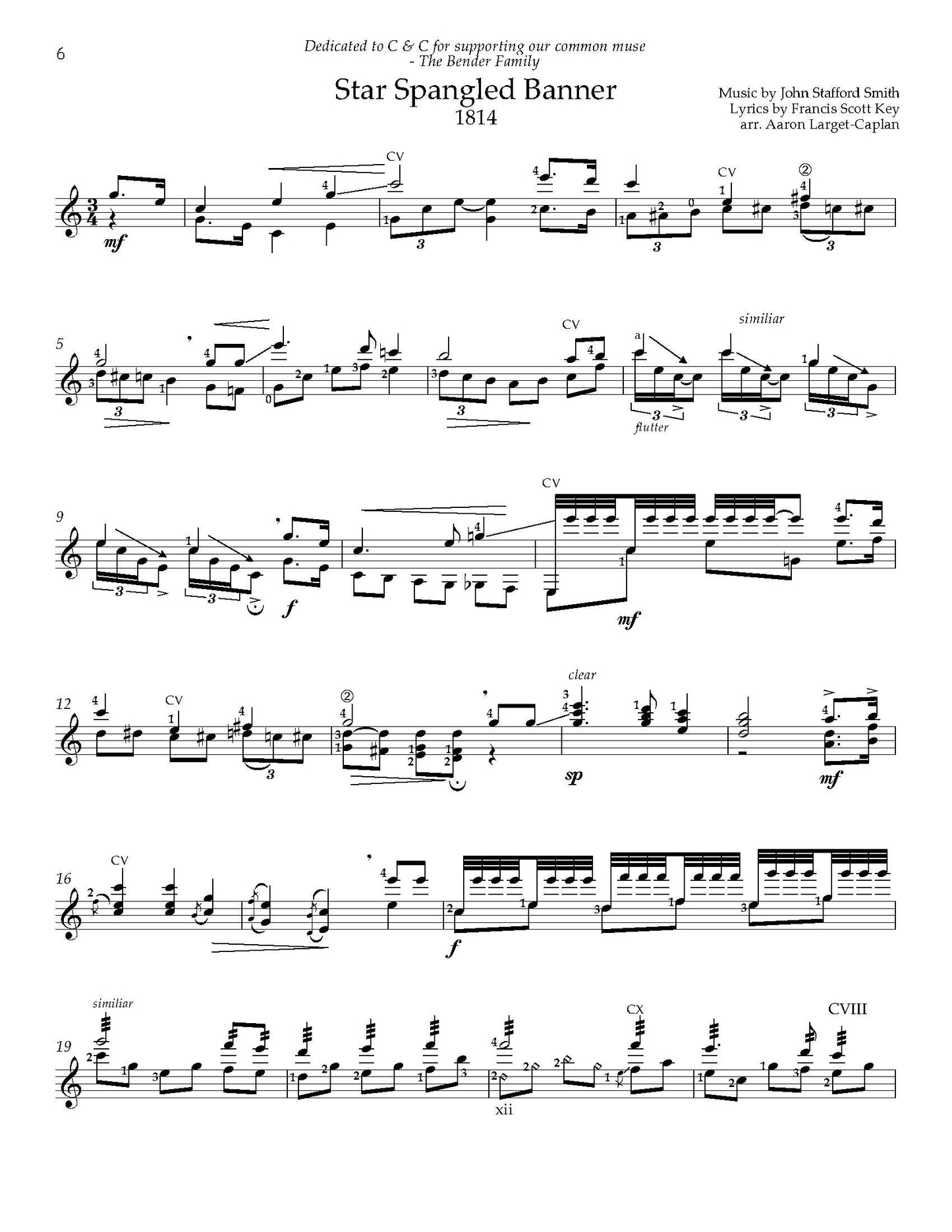
Star Spangled Banner
The original song “To Anacreon in Heaven" was written by British amateur musician John Stafford Smith in 1773. Francis Scott Key wrote the lyrics in 1814.
The arrangement includes chromatic movement in the accompaniment and tremolo as sustain (ms.11, 37). Measures 29-33 quotes ‘Taps’ (1862) by General Daniel Butterfield, as a nod to the iconic 1969 performance by Jimi Hendrix at Woodstock where he did the same as a protest against the US Government’s actions in Vietnam. It should be a complete break in tempo and feeling from the surrounding celebratory sections.
Over There
Written in 1917 as a call to arms for the First World War. The opening recalls a three-note bugle call, and the lyrics famously use, ‘The Yanks are coming”.
The arrangement uses jumps in register and tremolo to delineate the various parts and march-like feel. The staccato notes in the melody and bass line should be clear and succinct. An alternate fingering without tremolo is offered at the end of the collection.
Battle Cry of Freedom
Also known as ‘Rally Around the Flag’ and written in 1862 by George F. Root. A patriotic song advocating for both Unionism and abolitionism, it became so popular that it was adapted for the Confederacy, though with different lyrics.
The arrangement calls for a slower tempo overall, though it can pick up for the choruses. The melody in each verse is either in the upper or lower voices. Each chorus harkens to steel string folk guitar and the use of a plectrum. Though the term rasgueado is used, the strum should not sound Spanish.
Bill of Rights, Amended
James Madison, Amended by Aaron Larget-Caplan in May 2025.
This poetic interpretation of the Bill of Rights seeks to engage with the foundational language of the United States, invoking both its ideals and the tensions that persist within them. By selectively omitting certain words, the work does not diminish their importance but rather draws attention to their absence, emphasizing the evolving relevance and fragility of these principles. Through this act of poetic reconfiguration, I aim to foreground areas of historical and contemporary neglect while reflecting upon aspects of the text that resonate with my present concerns.
Edited or Arranged by: Aaron Larget-Caplan
Movements: America, The Beautiful by Samuel A. Ward Battle Hymn of the Republic by Julia Ward Howe Lift Every Voice and Sing by J. Rosamond Johnson Star Spangled Banner by John Stafford Smith Over There by George M. Cohan Battle Cry of Freedom by George F. Root Bill of Rights, Amended by James Madison and Aaron Larget-Caplan
Authored (or revised): 2025
Published: 2025
Duration (minutes): 17
First performance: March 2026 on Navona Records by Aaron Larget-Caplan
Book format: Score
SKU
ACA-LCAA-003Subtotal
$21.50Couldn't load pickup availability