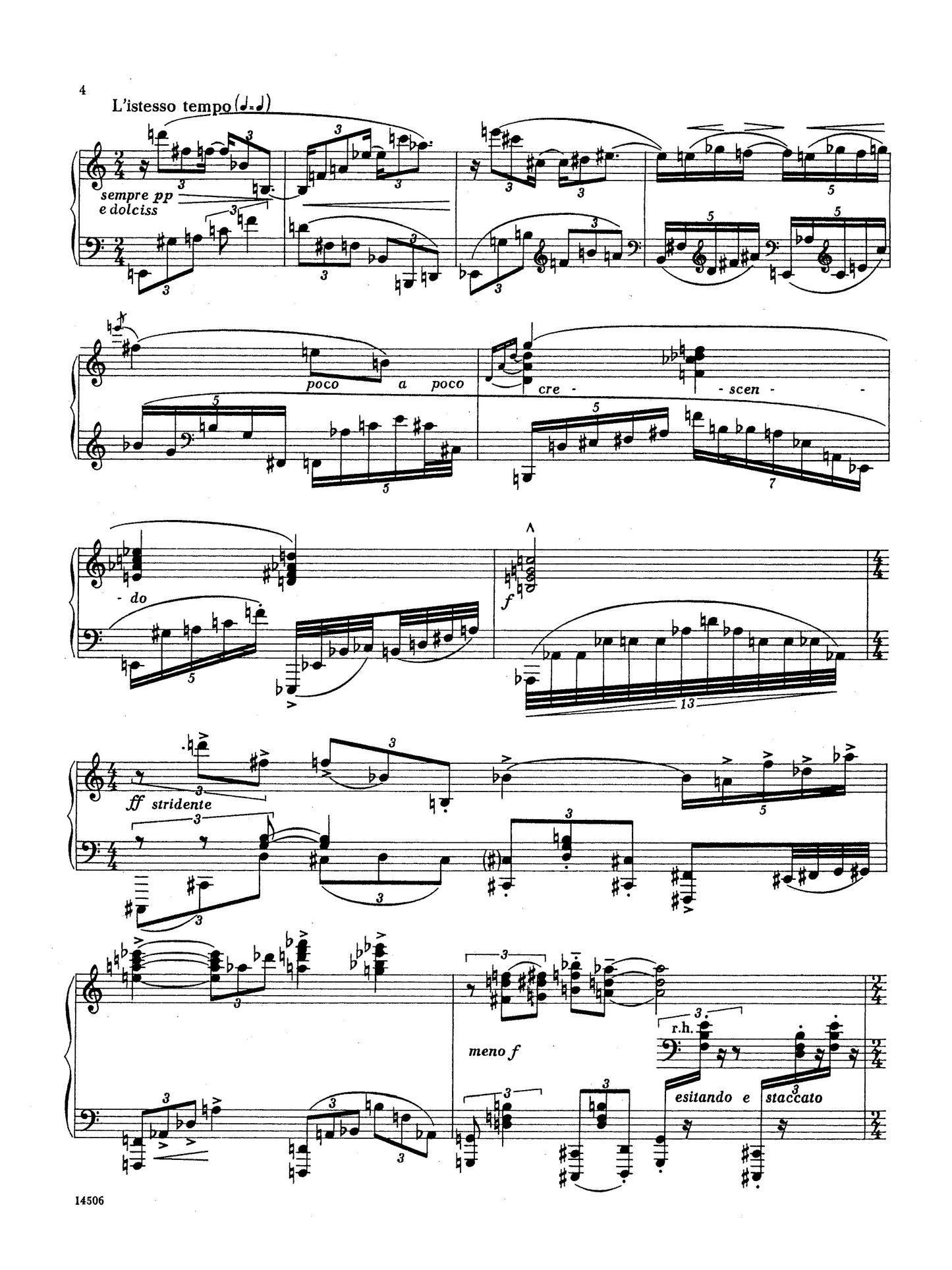
Fantasia (Variations), Op. 25
Fantasia (Variations), Op. 25
Piano
"In 1939 a young pianist called William Masselos made his debut at New York’s Town Hall playing, amongst other works, Copland’s Piano Variations. When Copland had finished writing his monumental Piano Fantasy in 1957, he admitted in a letter to Benjamin Britten that giving the first performance would be beyond him, and he decided to ask Masselos to play the premiere: ‘After hearing Bill play through the piece one day while he was testing pianos in Steinway’s basement, I really got excited: Masselos was a composer’s dream.’ (Copland since 1943; Aaron Copland and Vivian Perlis. St Martin’s Press, 1989)
Around a decade earlier Ben Weber had been similarly thrilled with the playing of William Masselos and decided to write him a serious piece for piano which became the Fantasia (Variations), premiered in March 1949 at Carnegie Hall, New York. Weber wrote in his unpublished autobiography:
I write pieces for my lovers […] when I dedicate a piece I don’t do it idly. I never did it with success on that level except with Billy Masselos, though it was not physical […] The Fantasia is a kind of bond between us, and when I wrote it deliberately, note for note, I was really making love to him through the avenues of sound. (How I took 63 years to commit suicide; with Matthew Paris)
(On a personal note I had the privilege of playing this piece for Masselos in the 1980s before he died.)
Ben Weber was born in 1916 in St Louis and was largely self-taught. His music was highly regarded by many composers of the time such as Copland, Carter, Cage and Babbitt, and he worked as a copyist for many, including Virgil Thomson and Artur Schnabel, both of whom became admirers and close friends. He was the first American composer to use the twelve-note technique consistently, and he made the following comments on his music (quoted by Oliver Daniel in an article for Broadcast Music Inc. in 1965):
By and large since 1938 my music has been usually atonal […] but sometimes I have written pieces which have strong functional and tonal impetus, or at least implication. However my use of ‘techniques with twelve-tones’, i.e. serial music, has been consistent over a period of now twenty-two years, and most of what I and some others consider to be my most important work is accomplished within these means.
The work is titled with a certain precision: Fantasia (Variations), the latter word in both brackets and smaller letters. Thus, like the Corigliano, this piece is principally a fantasy—a large form with smaller units creating a framework to hold the piece together. (As it is a piece using the twelve-note technique, it is by default ‘variations’—any twelve-note row can be seen as a ‘theme’ which is varied.) The overall structure of the work is three sections: first, a theme with four variations followed by a five-bar interlude; second, three variations in passacaglia form; finally, a free fantasy section based on earlier material which culminates in a climax surging with emotion. In contrast to the cool objectivity of the Copland work, the Weber revels in the sun of its post-Romantic harmony, and is freckled with tonal implications, in spite of the Second Viennese School ‘umbrella’. In fact there is even a whiff of Brahms’s cigar in the loose folds of the arpeggiated figuration, as well as the more exotic fragrance of Scriabin."
-- Notes on the work by Stephen Hough, 1998, Hyperion Records
Authored (or revised): 1946
Published: 2026
Duration (minutes): 8:30
Book format: Score
Historic material for this item is held at Special Collections in Performing Arts (SCPA) at the University of Maryland.
SKU
ACA-WEBE-031Subtotal
$17.00Couldn't load pickup availability