Keyboard Adventures: Rote Pieces for Beginners
Keyboard Adventures: Rote Pieces for Beginners
Piano
Rote teaching is a time-tested method in which the teacher demonstrates at the keyboard and the student learns by watching and listening and then imitating the teacher. Keyboard Adventures is intended as a supplement to traditional method books.
The rote approach allows beginning students to play relatively difficult music, with expression, in the first few weeks of lessons, before or while they learn to read music. Teachers do not need to have any background in rote instruction. Keyboard Adventures provides easy-to-follow teaching guidelines and techniques for presenting the pieces to students.
Many children have fairly sophisticated musical tastes and can become bored if they play only what they are able to sight read. And not every child is able to play by ear. The pieces in Keyboard Adventures introduce melodic, harmonic and rhythmic ideas that are far beyond the reading capability of beginning students - yet they are well within the beginner's ability to play and enjoy.
Keyboard Adventures also presents practice in transposition and lays the groundwork for learning the fundamentals of harmony, ear-training and improvisation. It capitalizes on the fact that large muscle control is more highly developed in young children than fine motor control; that is, movement of the whole arm as opposed to moving individual fingers. Rote teaching makes less demand on eye-hand coordination which is not always well developed in some young children.
The pieces in this collection range over the whole keyboard, with a great deal of crossing of hands so that students do not become fixed in five finger positions. Some students tend to become fixed in the middle of the keyboard and their hands can get tense. This can become a difficult handicap to overcome in developing a fluid technique which requires a flexible hand that is capable of easily changing direction and position.
Learning to play the piano must of course involve learning to read music. But by isolating the acquisition of one skill (learning to play) from the far more difficult skill (learning to read music) the student will find greater and more immediate satisfaction from music lessons and practice sessions. It is noteworthy that children learn to speak before they read. This can be applied to music lessons: play before or while learning to read.
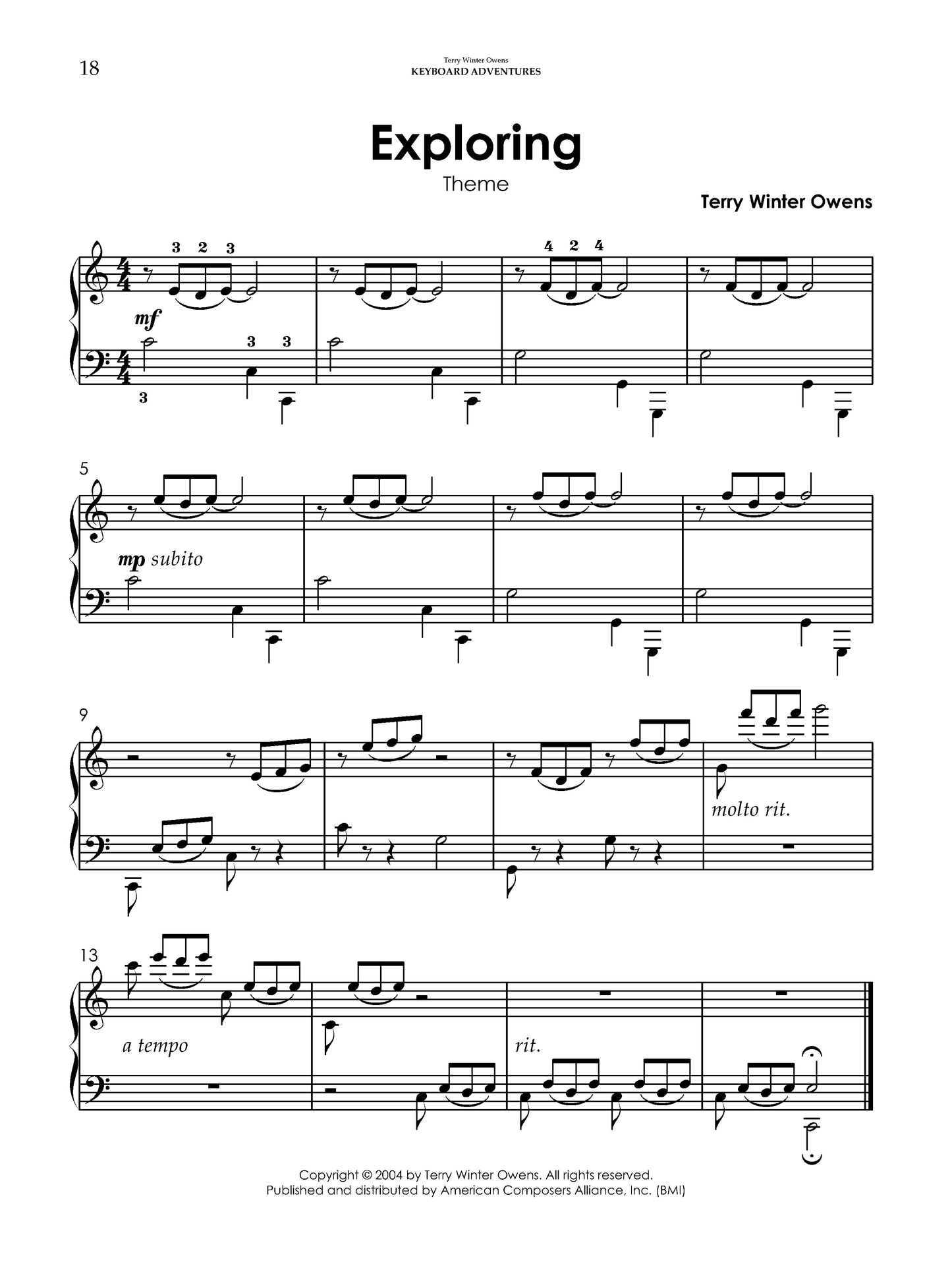
Movements: I. Ocean Tides: Theme and 2 Variations II. Catch Me If You Can: Theme and Variation III. Magic Tricks: Theme and Variation IV: A Faraway Kingdom: Theme and Variation V: Exploring: Theme and 2 Variations
Authored (or revised): 2004
Published: 2026
Book format: Score
SKU
ACA-OWEN-037Subtotal
$20.00Couldn't load pickup availability