Concerto for Piano and Orchestra
Concerto for Piano and Orchestra
Piano and Orchestra 3(3=picc)23(3=bcl)3(3=cbsn) - 4331 - timp, 2 perc - solo piano - strings
Editor's Note:
The New York Philharmonic, conducted by Dimitri Mitropoulos (1896-1960) — the dedicatee of the score — gave the world premiere of Philip Bezanson’s Concerto for Piano and Orchestra at Carnegie Hall on November 12 and 13, 1953, with pianist John Simms (1918–1992) as soloist.
For Simms, a native of El Dorado, Arkansas, the concerts marked his New York Philharmonic debut. His journey to that stage was remarkable: wounded in the hand during World War II, Simms nearly saw his career ended before it began, but surgery restored enough facility for him to continue. After the war, he studied at the Curtis Institute of Music, receiving his Bachelor of Music degree in 1947, followed by a Master of Fine Arts at the University of Iowa in 1950. That same year he was appointed Head of Piano at Iowa, a position he held until his retirement in 1986.
Philip Bezanson (1916–1975) was born in Athol, Massachusetts. He studied at Yale University, graduating in 1940, and after wartime service went on to the University of Iowa, where he earned both master’s and doctoral degrees. Bezanson remained at Iowa as professor of composition and eventually chair of the department, before later being recruited to the University of Massachusetts at Amherst as department chair and professor of composition, a position he remained in during the final decade of his life.
This concerto’s genesis sprang from a rather auspicious encounter. Mitropoulos, then music director of the New York Philharmonic, happened to hear Simms play several of Bezanson’s short piano pieces. Struck by the compelling nature of the music, he commissioned Bezanson to write a concerto on the spot — and programmed it for the Philharmonic’s subscription series at Carnegie Hall.
The New York Philharmonic designed a program that placed the new concerto in distinguished company. Brahms’s Tragic Overture set a dramatic opening, followed by the world premiere of Bezanson’s work. Louis Aubert’s Fantasie for Piano and Orchestra continued the evening, again with Simms at the keyboard, before the concert concluded with Brahms’s Symphony No. 4.
The effect was to situate Bezanson’s voice in dialogue with the Romantic tradition and with a modern European contemporary, while giving American audiences a first encounter with his unique and expressive musical language. According to the editor's convesations with the composer’s son, Tom Bezanson, who attended the premiere as an eight-year-old, the audience received the concerto with great enthusiasm, and simply would not stop applauding for an extended time.
Bezanson revised the concerto in 1960, though the process may have begun as early as the 1953 premiere. The original full score contains colored-pencil cross-outs and handwritten annotations adjusting slurs, orchestration, balance, and articulation; some of these markings may have been entered by Dimitri Mitropoulos during rehearsals, likely in consultation with the composer.
The 1960 revision was executed directly onto the original full score and orchestral parts rather than through newly recopied materials. The surviving sources therefore contain taped-on manuscript inserts, correction fluid, black-ink cancellations, and red-pencil deletions layered over the earlier notation. Although the manuscripts remained in storage for approximately sixty-five years—resulting in minor discoloration and surface wear—the revisions are largely legible. Because the changes were applied in successive layers, determining Bezanson’s final intentions required careful source evaluation. The revisions are primarily orchestrational, lightening texture, clarifying balance, and tightening ensemble coordination. Only a few passages alter musical content: the piano’s solo writing in the first movement is slightly shortened by the removal of two or three bars.
This edition has been prepared from the original New York Philharmonic parts, an annotated full score, and a handwritten two-piano reduction preserved in the composer’s archive at the Special Collections and University Archives (SCUA) of the University of Massachusetts Amherst. The materials presented substantial challenges, including yellowed tape repairs, obscured passages, and discrepancies between score and parts, some stemming from copyists’ errors or omissions. Careful editorial judgment was therefore required in preparing the first edition of the revised score.
For today’s listener, the concerto offers immediate impact. It carries perhaps a comparable primal rhythmic intensity to a work like Stravinsky's The Rite of Spring, a relentless drive that propels the music forward with visceral energy. At the same time, the score reveals a deep lyricism and emotional breadth (particularly in the second movement) — qualities that allow it to speak both to listeners with little prior experience of orchestral concert music and to seasoned connoisseurs of 20th-century concerto repertoire. Its moments of sweeping expressivity have the directness and evocative power of a great film score, while its rhythmic fire situates it firmly as an important work within the emerging American concerto tradition.
Neglected for too long, Bezanson’s Concerto for Piano and Orchestra deserves recognition as a significant and striking contribution to twentieth-century American music — a work at once accessible and sophisticated, personal and powerful, that now has the chance to speak again with the same vitality that so moved its first audience in Carnegie Hall.
- Michael David Golzmane
New 2026 engraved edition of 1960 second edition courtesy of Michael David Golzmane. Note that the recording embeded here is from the 1953 version.
Edited or Arranged by: Michael Golzmane
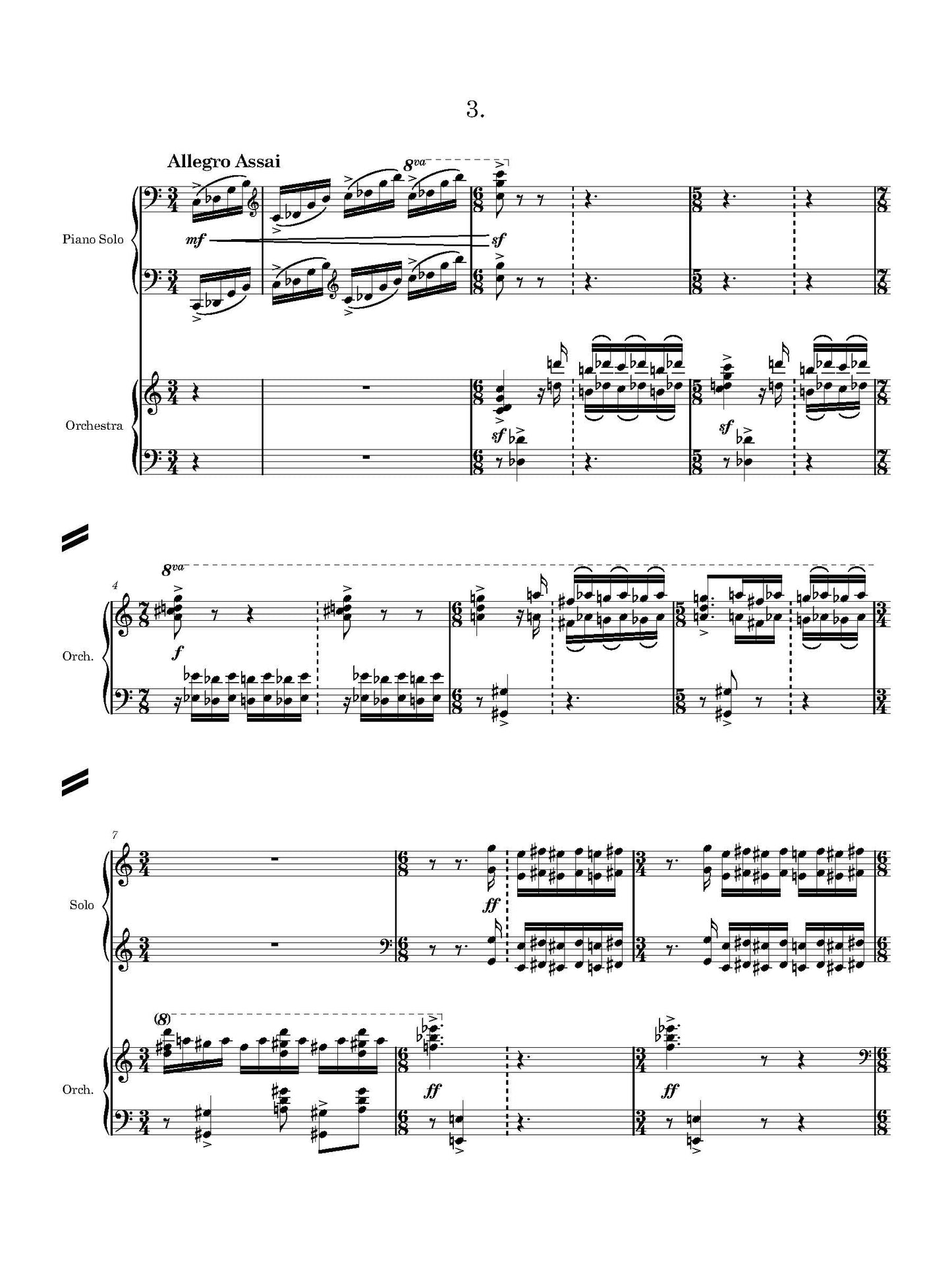
Movements: 1. Allegro con moto 2. Andante 3. Allegro assai
Authored (or revised): 1953
Published: 2026
Duration (minutes): 22
First performance: New York Philharmonic at Carnegie Hall, Nov. 12, 1953 - Dimitri Mitropoulos, conductor; John Simms, piano
SKU
ACA-BEZP-029sSubtotal
$130.00Couldn't load pickup availability