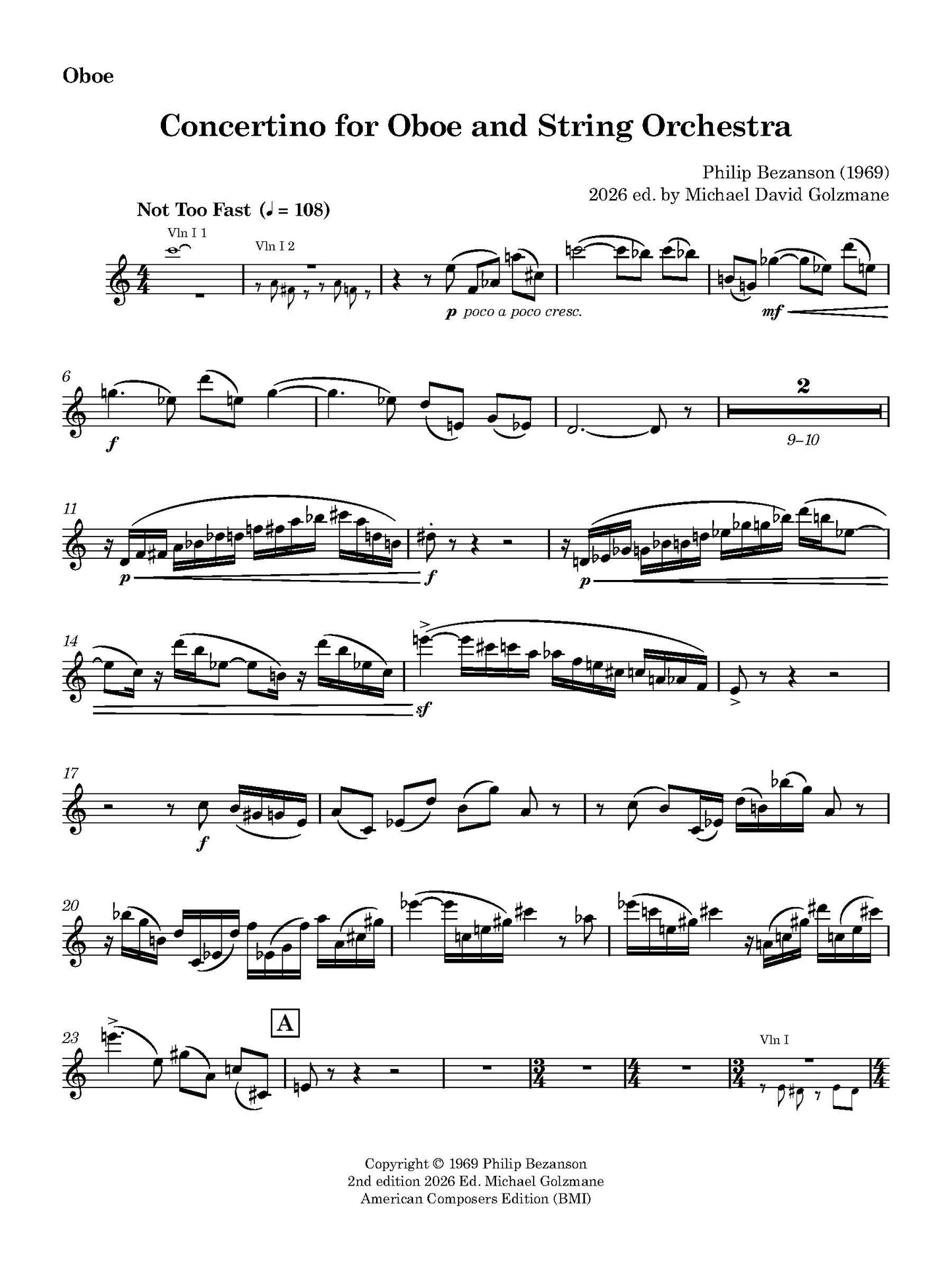
Concertino for Oboe and String Orchestra
Concertino for Oboe and String Orchestra
Oboe and String Orchestra
Editor's Note:
Philip Bezanson (1916–1975) composed the Concertino for Oboe and String Orchestra in 1969, during his years as chairman of the music department at the University of Massachusetts Amherst, a position he held from 1964 to 1973 after nearly two decades at the University of Iowa. The work survives in two scored forms — for oboe and string orchestra, and for oboe and piano —and is in three continuous movements, marked Not too fast, Slow, and Fast. The manuscript is held in the Special Collections and University Archives (SCUA) at the University of Massachusetts Amherst.
The editor has confirmed two early performances, each using a different version of the work. The oboe-and-string-orchestra version was performed by William T. Gower, oboe, with the University of Southern Mississippi String Orchestra, Donald Munsell conducting, at USM in October 1970. Also on that program were the Sonata for Oboe and Piano by William Presser and the Sonata for Clarinet and Piano by Alvin Etler. The oboe-and-piano version was given as a “first performance” at a recital by Charles Lehrer, oboe, on April 4, 1971, in Bowker Auditorium at the University of Massachusetts Amherst; the pianist was likely Dwight Peltzer.
Because the oboe-and-piano version was performed publicly during the composer’s lifetime — at his own university in 1971 — it appears to be a performance version that Bezanson sanctioned, and not merely a piano reduction intended for rehearsal. Performers may therefore present the Concertino either in its string-orchestra scoring or with piano.
Charles-David Lehrer (born 1940) was the oboe professor at the University of Massachusetts Amherst from 1967 until about 1985, when Fredric T. Cohen succeeded him. He studied with John de Lancie, Louis Rosenblatt, Alfred Genovese, and Ralph Gomberg, and held a Doctor of Musical Arts degree from the University of Michigan (1968) and later a Ph.D. from the University of California, Los Angeles (1990). He subsequently taught at California State University, Northridge, and worked as an editor and scholar for the International Double Reed Society, specializing in the history of the oboe concerto.
William T. Gower was a professor of music at the University of Southern Mississippi, where he joined the faculty in 1963 and conducted the University Symphony Orchestra; the university’s annual concerto competition is named in his honor. An Iowa native, he had earlier been on the faculty of the State University of Iowa, where Bezanson taught until 1964, and had been first oboist of the Denver and Tri-City symphony orchestras and solo oboist of the Chicago Little Symphony.
New Aug. 2026 engraved edition from 1969 original manuscript courtesy of Michael Golzmane.
Edited or Arranged by: Michael Golzmane
Authored (or revised): 1969
Published: 2026
Duration (minutes): 7
First performance: William T. Gower, oboe; University of Southern Mississippi String Orchestra, Donald Munsell, conductor, at USM in October, 1970
Historic material for this item is held at Special Collections in Performing Arts (SCPA) at the University of Maryland.
SKU
ACA-BEZP-008sSubtotal
$34.00Couldn't load pickup availability