String Quartet: "O Sapientia/Steal Away"
String Quartet: "O Sapientia/Steal Away"
String Quartet
Composer's Note:
This, my first string quartet, was completed on August 3, 2004, though the first sketches for it date from early 1996. Its progress has been interrupted numerous times over the years—sometimes by other pieces that needed to get written first, sometimes by life’s other demands on my time and energy. Mainly, however, the quartet simply took its time patiently teaching me what it wanted to be, and consequently much music originally intended for it got written and tossed out. I can only assume that somehow I needed to write through all of that ultimately discarded material in order for the finished product to emerge. It bears two dedications, one for the entire work to my wife, Susan Orzel-Biggs, who has put up with the inevitable moodiness attendant upon such a long gestation and birthing process, and an additional one for the third movement, in memory of my dear friend and mentor, Tony Lee Garner, an amazingly versatile conductor, singer, teacher, director and actor who left this earth much too soon in the early summer of 1998. While not tonal in the narrowest and most precise sense, the quartet does have a number of prominent pitch centers, the most significant of which are G-sharp (A-flat) and F-sharp (G-flat).
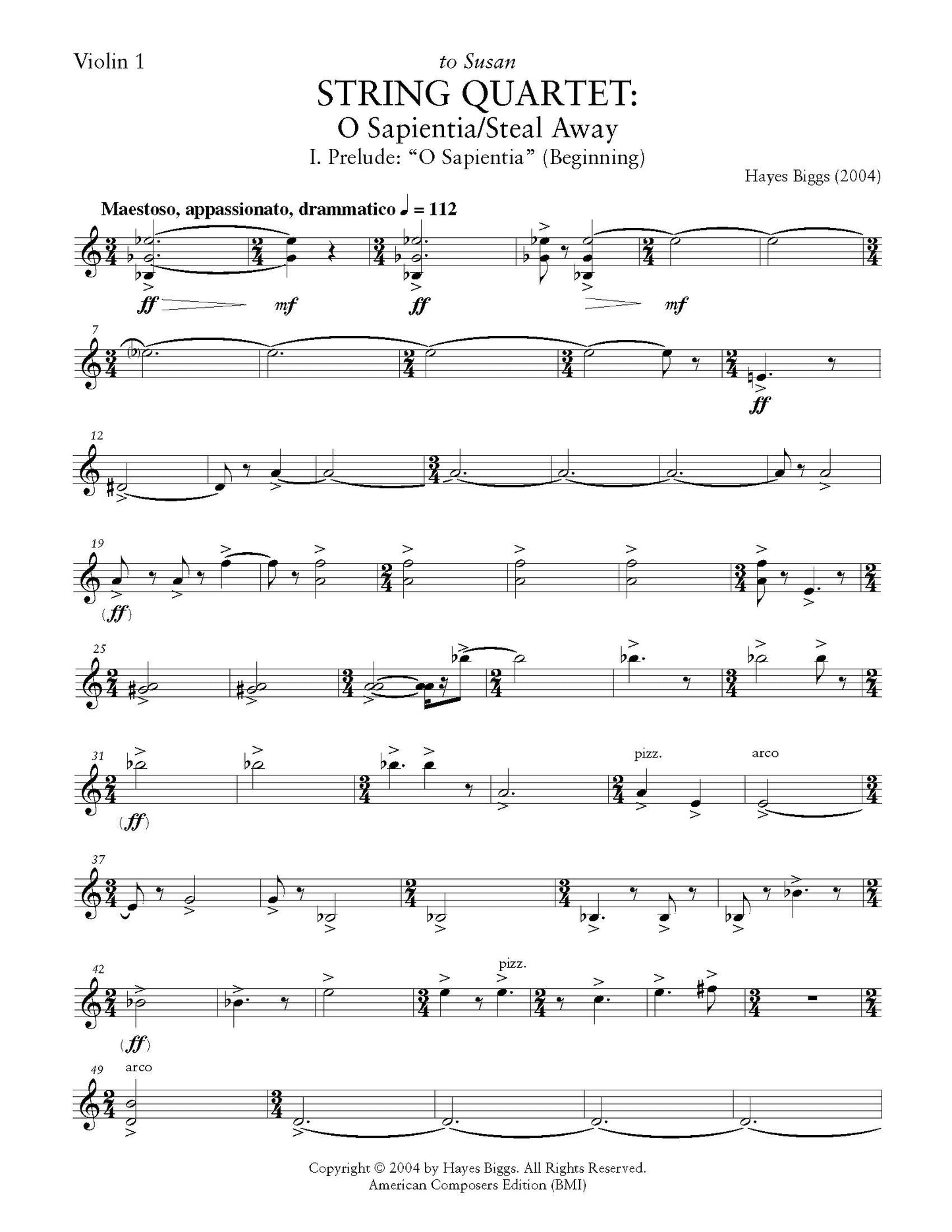
String Quartet: O Sapientia/Steal Away is in three movements played without pause, and lasts about 25 minutes. The first movement — Prelude: “O Sapientia”
(Beginning) — is marked Maestoso, appassionato, drammatico, and commences with a series of obsessively repeated E-flat minor triads in second inversion. These harmonies introduce a chordal passage built on pitches derived from the letters of Susan’s and my names. Eventually the instruments converge on a unison F natural, which ushers in an extended quotation of the first half of my Advent motet O Sapientia, composed in December of 1995. This quotation is interrupted twice, first by the opening E-flat minor harmony, and then, at the end, by a different sequence of three chords, also repeated obsessively, with measured silences in between. The Latin text of the motet is taken from one of the traditional Advent antiphons that all begin with the word “O.” These antiphons (which also include O clavis David, O Rex gentium, etc.) are best known to English speaking Christian worshipers as the individual verses of the Advent hymn “O Come, O Come, Emmanuel.” The words of the first portion of the motet can be translated roughly as follows: “O Wisdom that proceeded from the mouth of the Most High.”
The second movement — Interruption (Scherzo-Trio-Scherzo) and “O Sapientia”
(Conclusion) — starts without a break. It is marked Vivace e leggerissimo. The obsession at the outset of this movement is with rapid repeated single pitches, and the Trio that follows, marked Gioviale, uses a rather bent harmonic succession that makes much use of the final chord of the motet, curiously rendered in a frozen, motionless and vibratoless state, before the somewhat truncated return of the Scherzo. Along the way, an attentive listener may detect a very fleeting reference to the repeated note motive of the second movement of Beethoven’s String Quartet, Op. 59, No. 1 as well as a quotation from the Finale of Mozart’s Quartet, K. 387. Near the end of both Scherzo sections I also quote from a setting I made in the early 1980s for soprano voice and piano of a W. H. Auden poem; this quote begins with a rather jaunty unaccompanied scalar descent for the first violin. A reminiscence of the obsessive, hammered chords from the end of the first movement returns, with other harmonic reminders of the conclusion of the Trio, cut off abruptly and followed by a measure of silence. The plea initiated in the first part of the motet is at last completed in my subsequent quotation of the second: “Come and show us the way of prudence.” As the final chord is sustained in the upper three parts, the cello gives a brief preview of the subject of the next movement, the African-American spiritual Steal Away, quoting the motive associated with the words “steal away home.”
When I arrived at Southwestern at Memphis (now Rhodes College) in 1975 to begin my Freshman year, I auditioned for and had the privilege of being accepted as a member of the college’s superb chorus, the Southwestern Singers, directed by Tony Lee Garner, a man who probably taught me as much about the joys and responsibilities of being an artist as anyone before or since. My interest in writing for chorus was certainly stimulated by his influence, and he also must get credit for pointing the way to another hugely influential figure in my life, my first composition teacher Don Freund. I continued to sing with, learn from and work with Tony in various musical ventures over the years, and often looked to him for counsel long after I had left Memphis. Hardly a day goes by that I don’t think with pleasure and gratitude of our years as friends and colleagues. For our 1976 spring choir tour the Singers learned a program of American music that we also sang on a three-week tour of Romania later in the summer. One of the selections was William Dawson’s beautiful and extraordinarily moving arrangement of Steal Away, which has haunted me ever since I first sang it under Tony’s direction. The printed key of Dawson’s arrangement is F major, but Tony preferred it up a half step, feeling that the transposition better suited the sound of the choir. Thus the opening (III.a. Epigraph) of the last movement — “Steal Away” (in memoriam T. L. G.) — begins with a fairly straightforward presentation of the tune in the key of G-flat major, and the main body of the movement (III.b. Fantasia) is an extended lyrical—at times tempestuous—meditation on the spiritual.
Movements: I. Prelude: “O Sapientia” (Beginning) II. Interruption (Scherzo-Trio-Scherzo) and “O Sapientia” (Conclusion) III. “Steal Away” (in memoriam T. L. G.) a. Epigraph b. Fantasia
Authored (or revised): 2004
Published: 2025
Duration (minutes): 24
First performance: December 2006 at Merkin Concert Hall in New York City by the Avalon String Quartet
SKU
ACA-BIGH-007Subtotal
$91.00Couldn't load pickup availability