Reveries. Passions.
Reveries. Passions.
Violin, Viola, Cello, and Piano
Composer's Note:
I began working on Reveries. Passions. in 1990. It is a piece that, it turns out, I was not yet ready to write when I began struggling with my initial ideas for it. In addition, the vagaries of life and various other projects got in the way, and, though I occasionally glanced at it and picked at it a bit, I basically put it away for about 20 years and really didn’t resume work on it in earnest until around 2012.
The quartet might be described as a reflection of my love of nineteenth century music, particularly in its more obsessive and extreme manifestations. My title refers to that of the opening movement of Symphonie fantastique: Épisode de la vie d'un artiste ... en cinq parties (Fantastical Symphony: Episode in the Life of an Artist, in five parts) by Hector Berlioz (1803-1869), an arch-Romantic if ever there was one. The beginning of the composer's program for his symphony reads as follows:
“A young musician of unhealthily sensitive nature and endowed with vivid imagination has poisoned himself with opium in a paroxysm of love-sick despair. The narcotic dose he had taken was too weak to cause death but it has thrown him into a long sleep accompanied by the most extraordinary visions. In this condition his sensations, his feelings and memories find utterance in his sick brain in the form of musical imagery. Even the beloved one takes the form of melody in his mind, like a fixed idea which is ever returning and which he hears everywhere.” (Do not try this at home.)
Berlioz’s inspiration — his idée fixe — was an Irish actress, Harriet Smithson, whom the composer had seen play the role of Ophelia in a production of Shakespeare's Hamlet in Paris in 1827. He became obsessed with her even before he met her, sending her passionate love letters, to which she — not surprisingly — did not respond. Eventually he sublimated his feelings for her into his work on Symphonie fantastique, which he completed in 1830. Smithson did not attend the premiere, but she was present at a later performance in 1832, and being sufficiently impressed with Berlioz’s work (and possibly flattered to have provided the impetus for it), finally agreed to meet him. They married in 1833, but it didn’t work out; they went their separate ways after several unhappy years together.
During the course of Berlioz’s symphony, the beloved and her associated melody haunt the artist’s opium-induced dreams, at times tormenting him. In the fourth movement, Marche au supplice (“March to the Scaffold”), he dreams of being hanged for her murder, and in the finale, Songe d’une nuit du sabbat (“Dream of a Witches’ Sabbath”), her melody is transformed into a mocking, orgiastic dance at his funeral, a dance in which she is an enthusiastic participant.
My first exposure to this music occurred through watching one of the New York Philharmonic Young People’s Concerts on CBS in 1969, at the age of twelve. The title of this telecast was “Berlioz Takes a Trip.” In it Leonard Bernstein used Berlioz’s program to draw a connection between the drug-fueled dreams of the artist as depicted in the symphony and the use of hallucinogens such as LSD by hippies, rock musicians and other counterculture icons of the late 1960s. Bernstein touted Symphonie fantastique as “The First Psychedelic Symphony.” Berlioz actually had gotten the opium dream idea from having read, in his youth, Confessions of an English Opium Eater, a novel by Thomas De Quincey. (Berlioz himself did not use opium until his final years, when he was suffering from cancer and the drug was prescribed for him in order to alleviate his pain.)
While there are a couple of fleeting quotations from Berlioz's symphony, including one of the waltz melody from the second movement (Un bal — “A Ball), in my piano quartet, I would say that, musically speaking, my piece probably owes more to the influence of Robert Schumann (1810-1856), another Romanticist with a capital R, who in his own way was every bit as obsessive and impassioned as Berlioz. Schumann and Clara Wieck (1819-1896), the daughter of Robert’s piano teacher, Friedrich Wieck, met in 1830, the year that Symphonie fantastique was composed. Clara was but eleven years old when Robert moved into the Wiecks’ home to pursue his musical studies, and within a few years it became clear that the two were deeply in love. Clara, who had been a child prodigy, would become known as one of the great pianists of the age, and was an accomplished composer in her own right. Over her father’s objections, and only after prevailing against him in a protracted and acrimonious legal battle, Clara and Robert married in 1840. While they remained devoted to one another and their eight children, Robert suffered at various times from serious mental illness, which ultimately led to his attempting suicide by jumping into the Rhine River and his later commitment (at his own request) to an asylum, where he died at the age of 46. Clara, who remained an authoritative interpreter of and passionate advocate for her husband’s music as well as that of their friend Johannes Brahms, outlived Robert by 40 years.
When I began writing Reveries. Passions., I spent time looking at and listening to many quartets and quintets for piano and strings, from the standard ones by Mozart, Brahms, and Fauré to more modern examples by Aaron Copland and my first composition teacher Don Freund, but the one that had the most profound effect on me was Schumann's Piano Quartet in E-flat major, Op. 47, particularly its slow movement, with its beautiful cantilena and the scordatura low B-flat pedal point in the cello at the end. I quote from the opening of Schumann’s first movement near the conclusion of my quartet. Here is a brief synopsis of the three movements of Reveries. Passions.:
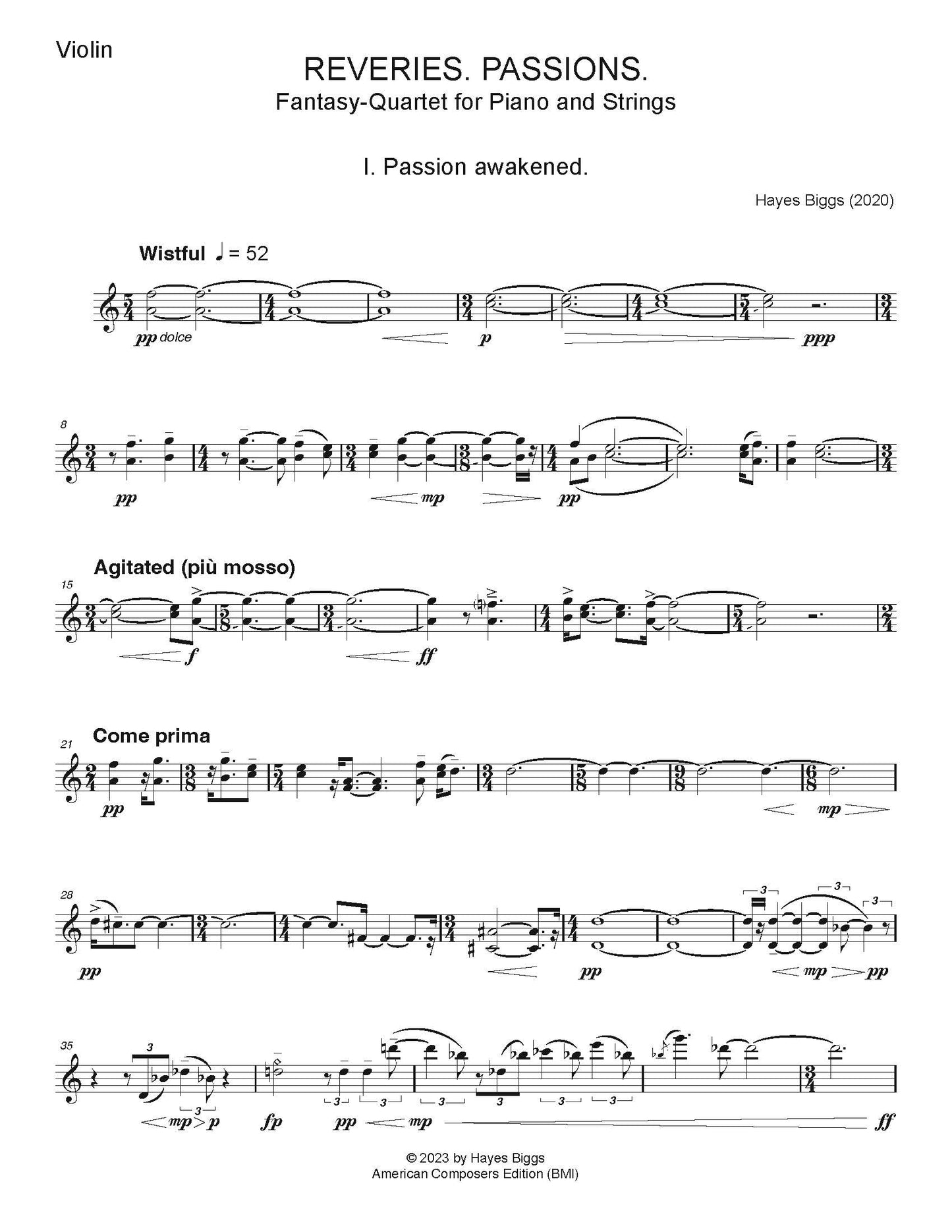
I. Passion awakened. The first movement, bearing the indication “Wistful,” starts softly and tentatively and becomes increasingly agitated, building to an outburst in the cello, marked appassionato, accompanied by tremolo figures in the other instruments. Once this has subsided, a lyrical tune is introduced in the viola and developed, ultimately leading to a recapitulation of the opening material and a subdued, somewhat austere and desolate sounding coda.
II. Passion mocked. This scherzo is a flippant, sardonic take on the folksong “Barb’ry Allen.” The lyrics of that song — which with the right performer can be a very sad, beautiful and moving one — concern a young woman spurning the love of her suitor, who lies on his deathbed. She is angry that he once slighted her while drinking toasts with and to his friends at a tavern, and on her arrival at his bedside she greets him coldly with the words, “Young man, I think you’re dying.” After she leaves and the young man proves that her observation was indeed correct, Barb’ry Allen hears his funeral bells tolling and dies of a broken heart. In many versions of the song, the two end up buried in the same churchyard, and a rose growing from his grave intertwines with a briar growing from hers in a “true lovers’ knot.” My treatment of the song ignores these more heartwarming parts of the story.
III. Passion recalled. Marked “Lento (Wistful),” this movement commences with a ruminative — one might say bittersweet — piano solo, which gradually grows in volume and intensity, culminating in the sudden entry of the strings, which bring back material from the first movement, including the lyrical tune initially heard in the viola (the same instrument that plays it this time around). After the climax, all the instruments join to recap the material of the opening piano solo, eventually introducing the Schumann quotation and a quiet ending.
Movements: I. Passion awakened. II. Passion mocked. III. Passion recalled.
Authored (or revised): 2020
Published: 2025
Duration (minutes): 30
First performance: May 31, 2023, Merkin Concert Hall, Kaufman Music Center, New York, NY, performed by Curtis Macomber, violin; Lois Martin, viola; Chris Gross, violoncello; Christopher Oldfather, piano.
SKU
ACA-BIGH-003Subtotal
$94.50Couldn't load pickup availability