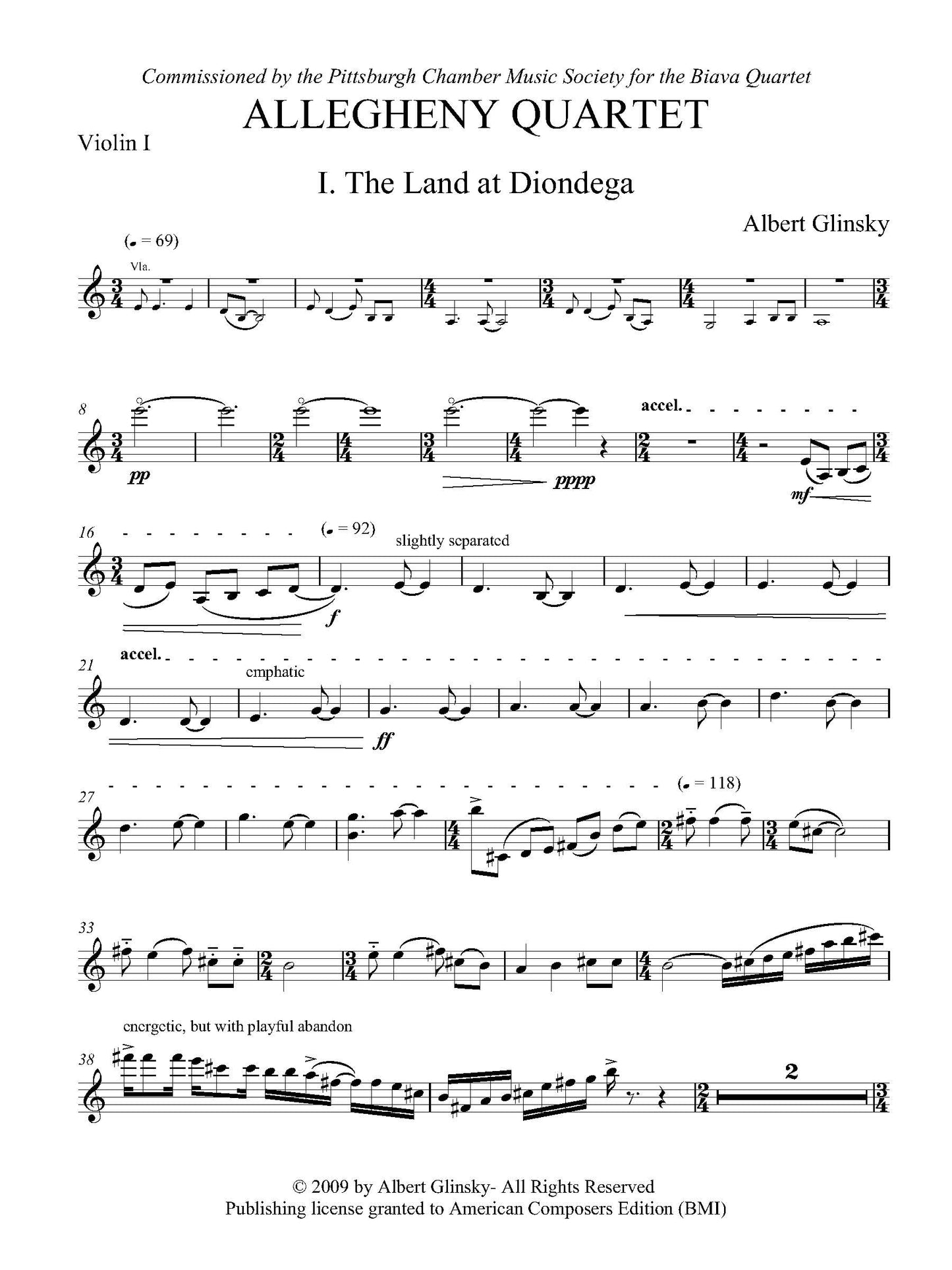
ALLEGHENY QUARTET
ALLEGHENY QUARTET
String Quartet
Composer's Note:
The Allegheny Quartet is a 4-movement time travelogue through the multicultural history of Pittsburgh from its early days as an important frontier to the west, through the struggles of its immigrant population in building the steel industry, to the pride of the shining modern metropolis of today. As I began the work, my research took me to such Pittsburgh sites as the Fort Pitt Museum (dedicated to the French and Indian War), and the Bost Museum in Homestead that houses information on Pittsburgh's steel heritage. The primary thematic materials forming the basis of the quartet are drawn from indigenous tunes and folk music associated with the history of Pittsburgh and the region. In all, eleven melodies from various ethnic groups, nationalities, and specific historical events are used. Thematically, the music folds back on itself in many places, and the tunes and their related motives sometimes reappear from movement to movement, often in counterpoint with each other. Taken as a whole, the work is designed to reflect the spirit of the city and provide the listener with a journey through its diverse evolution.
Movement I: The Land at Diondega
The title refers to the early Native American term for the land where the Allegheny and Monongahela Rivers meet to form the Ohio River. The movement begins with a traditional Iroquois "Dream Song," intoned on the solo viola, evoking a Native American resident of the virgin forest land that would be Pittsburgh, chanting alone to the trees. During the course of the movement the French settlers begin to gather, and are represented by a traditional French song from 1755, "La Courte Paille." The movement continues with the introduction of the English settlers through the period song, "The Little Turtle Dove." The ensuing battle among these parties (and their associated melodies in the development section of this 'sonata form' movement), representing the French and Indian War, ends with the British melody emerging from the contrapuntal "struggle" of the tunes. The raising of the British flag in November 1758 over Fort Duquesne (soon after to be named Fort Pitt), was the anniversary the Allegheny Quartet was commissioned to commemorate.
Movement II: Magarac's Dream
The title refers to "Joe Magarac," the Eastern European immigrant's equivalent of the American folk hero, John Henry. Magarac was a mythical figure about whom many stories of heroism were spun. In particular, Magarac was said to have performed feats of extraordinary strength in the Pittsburgh steel mills, and he was a symbolic hero of many steelworkers. The reality of the immigrant's dream of prosperity, however, was usually one of poverty and despair with horrific working conditions and meager salaries. The title of the movement, then, has a double-edged meaning. It is the "dream" of the men who came to America to become new Magaracs, but at the same time, the shattering of that dream. The principal melody of this movement, intoned first by the viola, is based on a song written by Andrew Kovaly, a Slovakian immigrant who worked in the Pittsburgh steel mills. "I Lie in the American Land" was penned to comfort the wife of Kovaly's steel mill friend, who, newly arrived in America with her children at the behest of her husband, learned that he had just been killed in the mills. The movement is a spiraling elegy of free variations on this tune. The Eastern European folk inflections in the music evoke some of the spirit of those whose lives were consumed by the steel mills. Following the impassioned central section which builds to a climax in the high register, the music floats downward and falls into a traditional Greek tune, "The Immigrant's Heartbreak," a song akin to "I Lie in the American Land," set as a little Greek dance. This tune winds down and we hear a final reprise of "I Lie in the American Land." In the coda, the major key statement of a motive from the melody represents an element of hope, and the final consonant/dissonant chord that ends the movement is an affirmation of bitter pride.
Movement III: Men of Steel
(Biava Quartet plays the third movement, see youtube link)
(Biava Quartet plays the third movement, see youtube link)
This scherzo movement grows out of motivic ideas I "translated" musically from a recording of actual steel mill sounds. There are whistles, rumbling effects, sirens, and the sounds of crashing metal fragments. Out of the churning machine four tunes emerge, each associated with the steel or coal industries in Pittsburgh. The 19th century African American song, "Coal Diggin' Blues," heard in the unison cello and viola, represents a sort of chanting "chain gang." This tune moves immediately into the Slovakian song, "Aja Lejber Man," (I'm a labor man), another melody associated with the mills. The setting suggests an Eastern European folk band with a violin, an accordion, and a pizzicato double bass. The two tunes then mingle in counterpoint and are swallowed up by the sounds of the mill machines. Two other tunes emerge from the furnace as the machine noises morph first into "Two Cent Coal," a song written about a coal workers' incident in Pittsburgh in 1876. The jig-like setting is followed by "The Homestead Strike," a protest song about the 1892 incident in which Andrew Carnegie locked out striking steel workers resulting in a riot that killed a number of people. “The Homestead Strike” and “Two Cent Coal” then combine, and are absorbed back into the steel mill with the machine triumphant all the way to the coda. Overall, the movement depicts a relentless industrial monster which, at times, reveals the various ethnic groups slaving in its vast belly, only to swallow them up again.
Movement IV: River City Mecca
The movement begins with a chorale-like setting of the folksong, "Where the Old Allegheny and Monongahela Flow,” a sentimental ballad popular with early 20th century barbershop quartets in Pittsburgh. The movement continues with upbeat variations on the song, "Pittsburgh Town," a tune attributed to Woody Guthrie when he passed through the city in 1941. A short interlude is followed by a minimalist-like section that builds and builds as we emerge from the dreams of the past into the present time, driving south on Interstate 279 toward the modern city of Pittsburgh (the "Emerald City” in the distance, growing ever closer). At a climactic moment, we break through a sonic wall, and the original Native American Dream Song of the first movement is heard, followed by an extended canon in which 8 tunes overlap in counterpoint (the Dream Song, “Coal Diggin' Blues,” “Aja Lejber Man,” and “I Lie in the American Land,” morphing gradually into a counterpoint of “The Homestead Strike,” “Two Cent Coal,” “Where the Old Allegheny and Monongahela Flow," and “Pittsburgh Town”). As the strains of each ethnic group bubble to the surface from their place in the foundations of Pittsburgh, a triumphant coda emerges, and the movement ends in a musical evocation of a shining modern city.
Commissioned by the Pittsburgh Chamber Music Society in honor of the 250th anniversary of Pittsburgh.
New 2025 edition from 2009 original.
Movements: The Land at Diondega Magarac's Dream Men of Steel River City Mecca
Authored (or revised): 2009
Duration (minutes): 27
First performance: May 30, 2009, Biava Quartet, New Hazlett Theater, Pittsburgh, PA
Historic material for this item is held at Special Collections in Performing Arts (SCPA) at the University of Maryland.
SKU
ACA-GLIN-005
Regular price
$134.00
Sale price
$134.00
Regular price
Unit price
per
Subtotal
$134.00Couldn't load pickup availability