From the Lamentations of Jeremiah the Prophet
From the Lamentations of Jeremiah the Prophet
Vocal Soloists (2 Sopranos, Mezzo-soprano, Mezzo-soprano, 2 Altos, Tenor, Bass), Mixed Chorus (SATB with divisi), Finger Cymbals and Piano Four-Hands
Composer's Note:
From the Lamentations of Jeremiah the Prophet was commissioned by All Saints Church in the City of New York, where I was a member of the choir for over 15 years. The choir of All Saints Church, under the direction of Dr. Gail Archer, first performed the work on Palm Sunday, March 24, 2002.
Traditionally, portions of the Lamentations of Jeremiah have been read or chanted as part of the Roman Catholic rite during Holy Week, with three lessons each appointed for Matins at Maundy Thursday, Good Friday and Holy Saturday. Many polyphonic settings of all or part of these traditional nine lessons have been made over the centuries by composers such as Lassus, Palestrina, Victoria, Tallis, Byrd, François Couperin, and, closer to our own time, by Ginastera, Krenek and Stravinsky.
In the original Hebrew, the verses of each chapter of the Lamentations form an acrostic. That is, if one takes the first letter of each verse of a chapter, one obtains the Hebrew alphabet in its usual order: Aleph, Beth, Gimel, etc. The letters were retained as verse headings in the Latin Vulgate translation of the Bible. Composers have traditionally set these to music, perhaps, in a way, as a kind of aural equivalent of ornate initial capital letters in an illuminated manuscript. In my setting I have retained this link with tradition. Besides being a useful formal device, the coolly lucid abstraction of the settings of the letters provides occasional welcome distance and respite from the intensity of the text.
The present work is about 16 minutes in duration and, in terms of verses selected for setting, it is roughly equivalent to one of the Maundy Thursday lessons. While the majority of the work is in English (from the Authorized King James version), I have retained Latin for the incipit and the final exhortation; the Latin is further employed at times as a background text.
The emphasis in the Lamentations is on the desolation of the city of Jerusalem after its destruction and the enslavement of its people, and on the need for repentance. In a larger sense, however, its stress is also on the desolation of the wounded human spirit, on the hope of God’s steadfast and enduring forgiveness and mercy, and on the possibility, however distant and improbable it may seem, of healing and reconciliation.
My setting begins with the somewhat raucous Íncipit Lamentátio Jeremíæ Prophétæ (“Here begins the Lamentation of Jeremiah the Prophet”). A cantor attempts to begin the chant, but is interrupted by the pianists and double choir, the chant tone being appropriated by the lower voices. The pianists present a brief postlude in three parts: first the basic polychords—that is to say, the sounding of more than one harmony simultaneously—that form a significant part of the musical language of this piece; secondly, a rather pallid version of the traditional plainchant; and, finally, another polychord that will also serve to begin the first verse of the text proper.
Chapter 1, Verse 1.
ALEPH. How doth the city sit solitary, that was full of people!
(Quómodo sedet sola cívitas plena pópulo!)
How is she become as a widow!
She that was great among nations,
And princess among the provinces, how is she become tributary!
(…princeps provinciárum facta est sub tribúto.)
The mezzo-soprano and alto soloists, along with the chorus, present ALEPH; the soloists continue with verse one, punctuated by a steady tolling bass in the piano and by occasional finger cymbals. The chorus interrupts with a "shadow" Latin version of the same text, using the chant tone, and later with a violent, mocking setting of the words, “she that was great among the nations and princess among the provinces.” The soloists complete their thought: “how is she become tributary!”
Chapter 1, Verse 2.
BETH. (Plorans plorávit in nocte)
She weepeth sore in the night,
And her tears are on her cheeks;
Among all her lovers she hath none to comfort her:
All her friends have dealt treacherously with her,
They are become her enemies.
(…et facti sunt ei inimíci.)
BETH starts with a restrained and placid unaccompanied passage for choral sopranos, altos and tenors, leading to a neo-Baroque setting for the full choir alternating with five soloists: two sopranos, mezzo-soprano and two altos. The choir sings only the Latin opening of the verse and the final lines of the movement; the soloists carry the main English text, including an imitative passage at the words “among all her lovers she hath none to comfort her.”
Chapter 1, Verse 12 (beginning).
LAMED. Is it nothing to you, all ye that pass by?
Behold and see if there be any sorrow like unto my sorrow.
(O vos omnes, qui transítis per viam, atténdite, et vidéte si est dolor sicut dolor meus.)
LAMED is for the choir and pianists, again presented in a more restrained fashion.
A soprano soloist introduces the main text, this time only the first part of verse 12, and the choral altos introduce the melody that will underlie the entire musical texture. This melody is heard three times complete, and the musical fabric grows out of it. The altos are joined gradually by the soprano soloist and the choral sopranos, and occasionally by the choral tenors and basses. The latter intone an altered form of the traditional chant for the responsory for Matins of Holy Saturday, O vos ómnes, the text of which is of course the Latin version of the beginning of this verse.
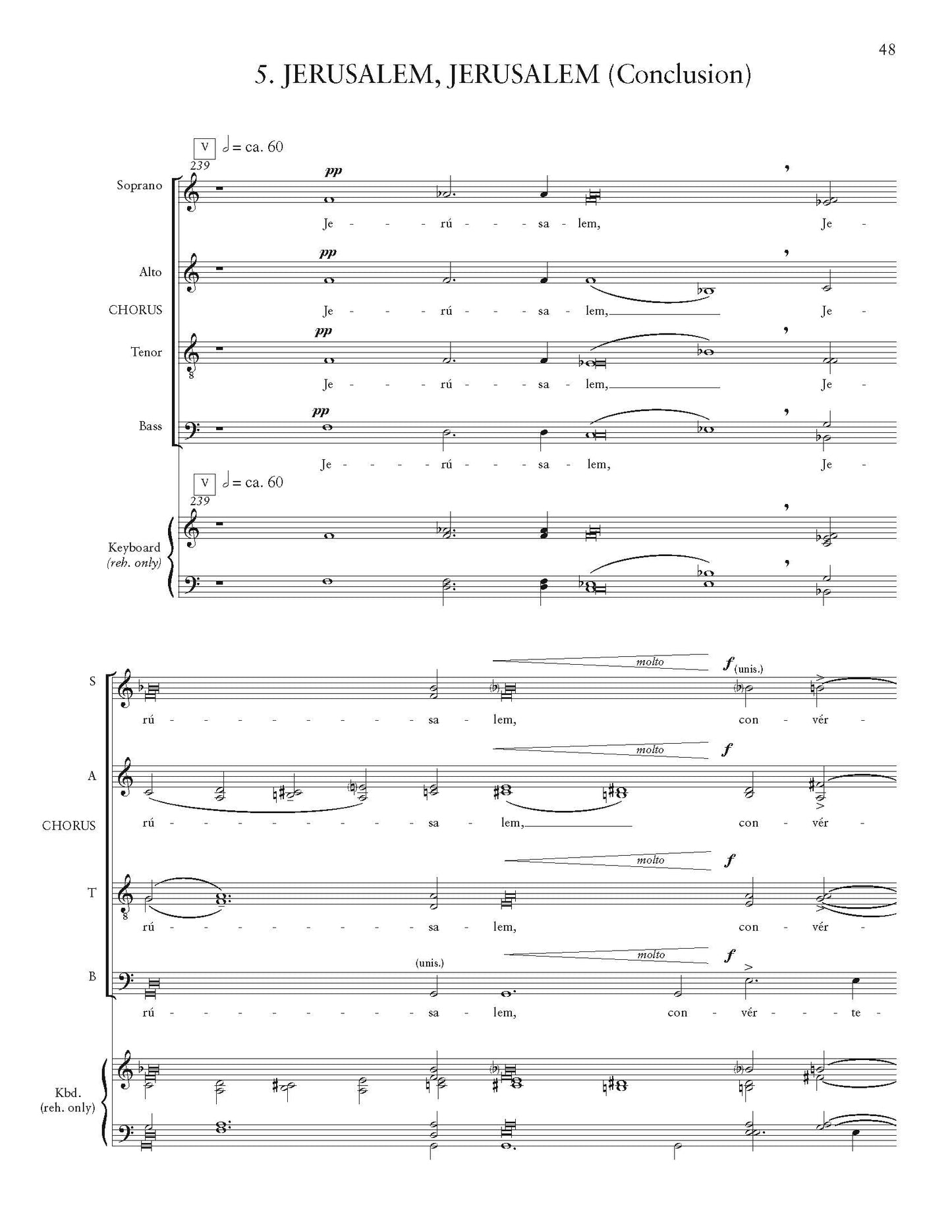
Jerúsalem, Jerúsalem, convértere ad Dóminum Deum tuum.
(Jerusalem, Jerusalem, return to the Lord thy God.)
In accordance with liturgical custom, the lesson concludes with an adaptation of words from the prophet Hosea, Jerúsalem, Jerúsalem, convértere ad Dóminum Deum tuum (“Jerusalem, Jerusalem, return to the Lord thy God.”) Beginning at “convértere,” the soprano line is derived from the motive that was used to set the words “behold and see” in the preceding passage, and the resulting harmonic “turning” underlines the message of this exhortation. This is one of few unaccompanied places in the entire work, but it ends with a final benediction in the piano’s secondo part, consisting simply of two quiet chords that were first stated at the end of the incipit.
Movements: 1. DE LAMENTATIONE: Íncipit Lamentátio Jeremíæ Prophétæ 2. ALEPH: Quómodo sedet sola cívitas 3. BETH: Plorans plorávit in nocte 4. LAMED: O vos omnes 5. JERUSALEM, JERUSALEM (Conclusion)
Authored (or revised): 2002
Published: 2025
Text source: Book of Lamentations
Duration (minutes): 16
First performance: The choir of All Saints Church, under the direction of Dr. Gail Archer, on Palm Sunday, March 24, 2002.
SKU
ACA-BIGH-014sSubtotal
$41.00Couldn't load pickup availability