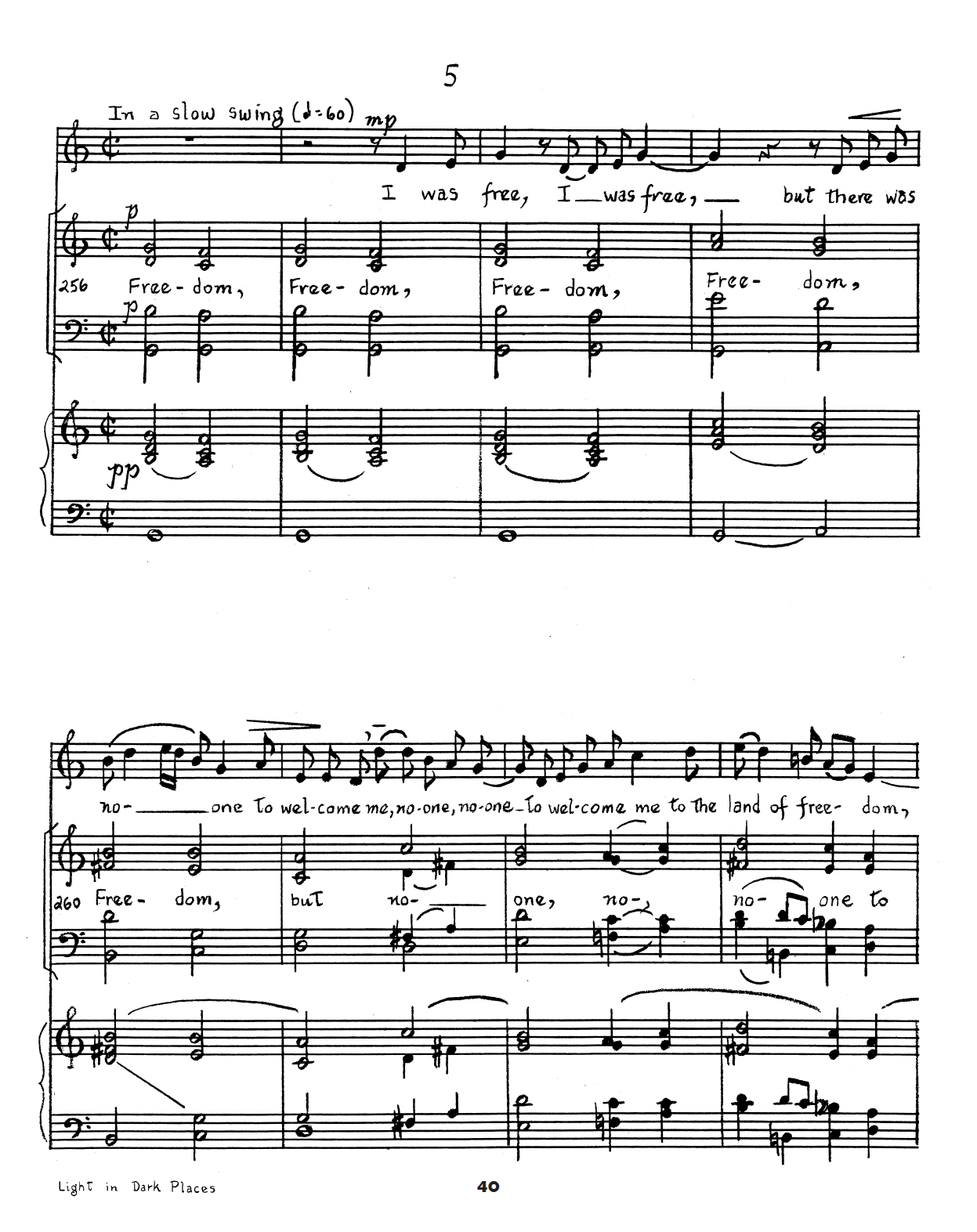
Light in Dark Places: Slavery and Freedom in Nineteenth-Century America
Light in Dark Places: Slavery and Freedom in Nineteenth-Century America
SATB Chorus and Piano
Composer's Note:
In 1988 I received a commission for a choral piece from North Central College in Naperville, Illinois.
Naperville is historically vital; it is older than Chicago, and conscious of its past. It was an easy step to conceive of a work that would take its departure from historical context: that of the slave life of the nineteenth century, together with freedom, as those who experienced it remembered it in interviews, letters, and other documents. The compilation of such documents from nineteenth-century women was in fact my current reading: "We Are Your Sisters: Black Women in the Nineteenth Century", edited by Dorothy Sterling. The voices of these women seemed so eloquent, and the subject so compelling, that I chose that historical context for the choral work.
I turned to the past also for the musical basis operandi: to the Black shout and spiritual for part of the material, and to the seventeenth-century concept of "tone" for other parts. "Tone" was a transitional theory that bridged the considerable distance between "mode" and "key." Of course, a composer rethinks such concepts in putting them to use in another era, and although the principle is the same, I used it differently. In brief, it is the concept of tone as materials related to a scale, major or minor, in which the functions inhere as individual tones, without reference to key--notably omitting the defining role of upper and lower dominants. This concept allows for use of the scale materials of a key without the functions of the key. Dissonance is not necessary, though it occurs occasionally by context, and chord progressions can be free and rich. "Tone" also frees the rhythmic life of the work, which I considered basic to the language I wished to create.
The third section of the work uses a tune known from the nineteenth-century (to that lyric), and I have provided it with a harmonization that transcends the concept of tone, but still based upon it.
It is my hope to honor the memory of the valiant women whose words speak so strongly so long after they were spoken.
Movements: Part 1: Slavery (3 movements) Part 2: Freedom (2 movements)
Authored (or revised): 1988
Published: 2025
Text source: Various 19th century black women: Margaret Walker, Matilda Dunbar, Harriet Tubman, Frances Ellen Watkins, and anonymous
Duration (minutes): 14
First performance: 1989, Binghamton, NY; commissioned by North Central College, Naperville, IL.
Historic material for this item is held at Special Collections in Performing Arts (SCPA) at the University of Maryland.
SKU
ACA-BORR-043sSubtotal
$46.50Couldn't load pickup availability