
BLAKE
A Musical Drama by H. Leslie Adams
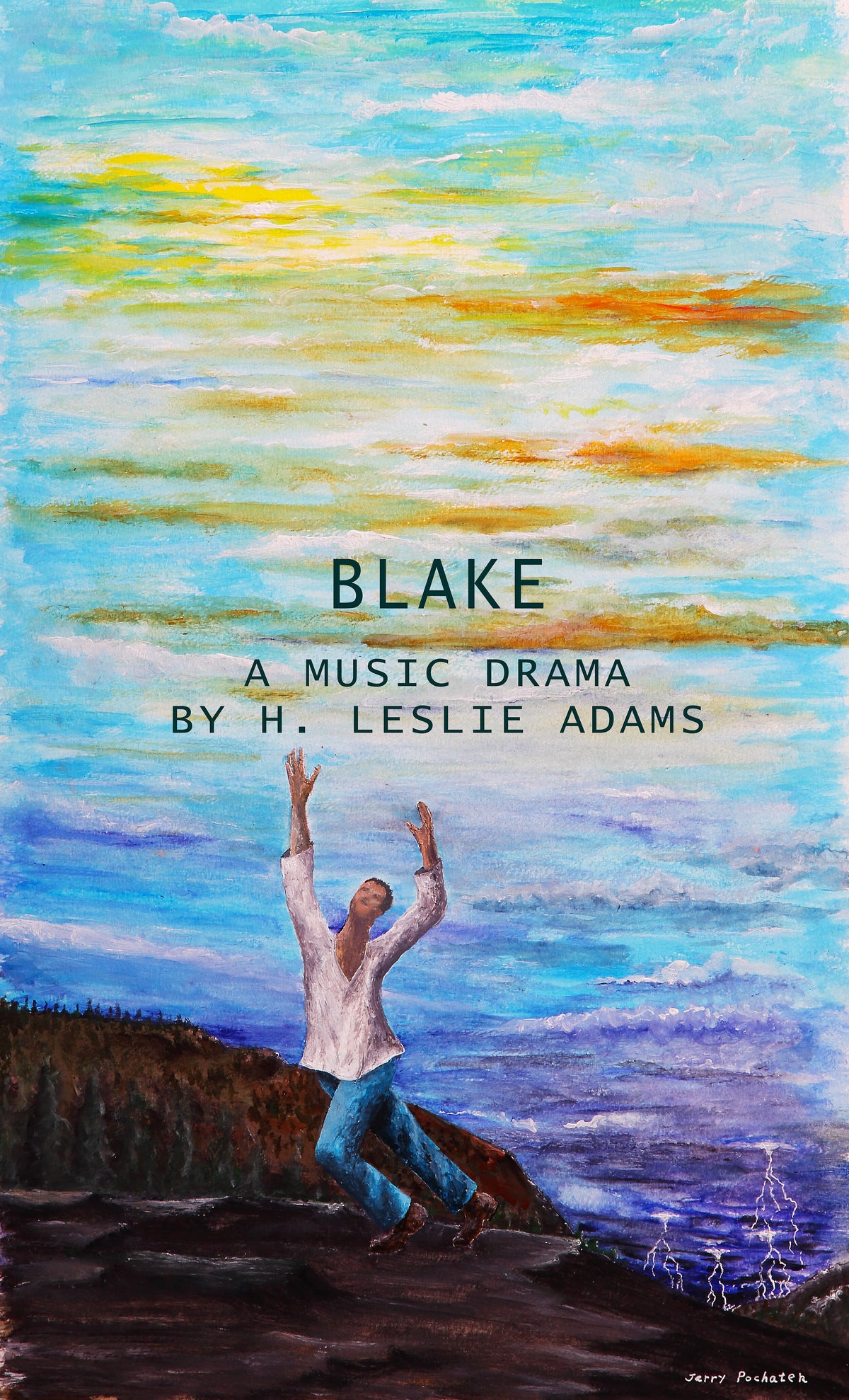
BLAKE is the story of young love, forced separation, and the search for one another and true love in the Antebellum South.
Suggested by an idea from a 19th century American novel by Martin Delany (1812-85), Blake recounts the story of a slave who resolves to lead his people out of bondage and to a life of dignity. The libretto presents Blake's quest against a background of intrigues involving the slave's authoritative master and the separation of Blake and his wife, Miranda, who is given away as a gift.
Staging Note: The composer and librettist favor casting this work in an inclusive manner in which multiple ethnic groups are represented throughout (visual representation of inclusion). The artistic objective for this is to align with the work's universality.
A Note from H. Leslie Adams
Blake is a music drama, so it's appropriate for both theater and opera lovers. The essence of Blake is universal. It's American history with themes of universal appeal. Regarding the latter, everyone's ancestor was a slave when one goes back far enough--which is what the ancient world was all about: conquering and being conquered, enslaving and freeing. Thus, it's about the human quest for freedom from bondage and domination, as depicted in this drama of young lovers.
Artistically songs, arias, duets, choruses and dance are featured in Blake. They embrace the broad spectrum of theater. The dance sequences provides instrumental improvisation with rich ethnic-oriented choreography.
All this is geared toward a wide audience. Its structure follows the landmark Broadway production Hamilton, namely visual representation of ethnicity incorporated into a large casting spectrum. For Blake the substantial use of contemporary syncopation and driving rhythms accommodates the younger audience. There are also major arias in the more traditional genre which speaks to opera enthusiasts. The story is quite simple and easily followed, which can easily utilize super titles.
All this points to a layered audience structure, which is the vision of this work's creators.
—HLA, 2019
Painting by Jerry Pochatek
For inquiries about presenting BLAKE, please contact
Black Tea Music: info@blackteamusc.com
Scores, aria extracts, and sheet music can be purchased at ACA.
Collapsible content
Overview of the Opera
Act One - late summer 1859 on the Stevens plantation near Natchez, MS
Scene 1 Blake's comrades, Andy and Jack (tenor and baritone) conspire with Blake about a freedom plan. When Andy and Jack leave, Blake's wife, Miranda (soprano) and Blake sing a tender love duet, prior to Blake's leaving for a journey to Natchez for the plantation master, Major Frank Stevens (baritone). Blake assures Miranda and their young son, Little Joe.
Scene 2 Blake departs for the journey in front of the main house, watched by plantation workers (chorus), the plantation mistress Joanna Stevens (soprano), and house guests from Charleston, Isabella Ballard (mezzo-soprano) and her brother Judge Whitney Ballard (bass). Later Frank and the Judge are revealed to be conspirators in a Nationalist plot to conquer Cuba and the Caribbean basin.
Scene 3 Isabella announces that she is taking Miranda away with her, a "gift" from the Major. Joanna and the Major quarrel over this, but the Major asserts his complete mastery over Miranda and orders her to be bound. The scene ends with Miranda facing an unknown future.
Act Two - 1859 at the Stevens Plantation called Tranquility
Blake returns, excited about what has happened to Miranda. He and the Major have a violent quarrel, leaving the Major dead and Blake a fugitive.
Act Three - October 1860 in Charleston, SC
Scene 1 Miranda is in her new home with the Ballards in Charleston. Isabella rebukes Miranda in a clash of ideals, and bids Miranda to help her pack for a trip to Cuba. Miranda, sensing that Blake and Little Joe must be alive and coming closer to her, vows to flee rather than go to a foreign country.
Scene 2 Blake dreams of Miranda as he and Little Joe pause in the forest during their journey.
Act Four - April 15, 1861. Set in the great dismal swamp between Virginia and North Carolina
In the Great Dismal Swamp Blake encounters a long established maroon camp. He is initiated in a colorful ritual featuring dancers and drummers. Word of the war is heard, when a wounded woman who, under the assistance of sympathetic Quakers, is brought into camp; it turns out to be Miranda! A poignant reunion takes place before Miranda dies in Blake's arms. News of the firing on Ft. Sumpter has established the beginning of the war. The group plans to move on to the hills until they can join forces led by Lincoln. Amidst a procession of great emotional intensity Miranda is carried away.
Cast of Characters
John-Henry Blake (tenor or high baritone) - Plantation steward
Major Frank Stevens (baritone) - Plantation owner
Joanna Stevens (soprano) - Steven's wife
Judge Whitney Ballard (bass) - Houseguest
Isabella Ballard (mezzo-soprano) - Judge Ballard's sister
Little-Joe, 8-year-old son of Blake and Miranda (spoken part)
Andy and Jack (Blake's comrades)
Mammy Juba and Papa Joe (Plantation elders)
Fourth act friends and comrades
Chorus
Orchestra
2 Flutes plus Piccolo
2 Oboes plus English Horn
2 Clarinets in B flat plus Bass Clarinet (with extension)
2 Bassoons
4 Horns in F
3 Trumpets in B flat
2 Tenor Trombones (the second with F attachment)
Bass Trombone
Tuba
Timpani
3 Percussionists
Afro-Cubano (or African) Auxiliary Drum Ensemble (8 performers)
Harp
Pipe organ or digital organ or keyboard (optional)
Strings
-
H. Leslie Adams
BLAKE: The Opera, Vol. 1: Prelude, Act 1
3332 4331 Timp, Perc (3), Afro-Cuban Drum Ensemble, harp, organ (keyboard), strings
$179.00 -
H. Leslie Adams
BLAKE: The Opera, Vol. 2: Acts 2, 3, and 4
3332 4331 Timp, Perc (3), Afro-Cuban Drum Ensemble, Harp, Organ (Keyboard), Strings
$246.50 -
H. Leslie Adams
BLAKE: Piano Vocal Selections
Solo and ensemble voices, with keyboard accompaniment
$194.00 -
H. Leslie Adams
BLAKE - Prelude to the opera (Orchestral)
2fl+pic, 2ob+eh, 2cl+bscl, 2bsn - 4 hn, 3tpt, 2tb+bstbn, 1tba, timp, perc(3), hp, strings
$45.50 -
-
H. Leslie Adams
BLAKE 02 - Oh John, My Love (Blake and Miranda)
Soprano, Tenor, and Piano
$12.00 - $16.00 -
-
H. Leslie Adams
BLAKE 06 - Aria: Our Losses Will Be Great (Stevens)
Baritone and Piano
$11.00 - $14.00 -
H. Leslie Adams
BLAKE 08 - That Wild Fire (Isabella's Aria)
Mezzo-Soprano (or Soprano) and Piano
$12.00 - $15.00 -
-
-


Critical Acclaim for Blake


