Skip to content

Marilyn Bliss

Email composer/representative direct: 
Email contact form
Email ACA Regarding This Composer: 
Email contact form
Short Bio: 
New York-based composer of classical concert music.
Biography: 

Iowa-born Marilyn Bliss (b. 1954) has written many widely performed orchestral, chamber, and solo works. Educated at Coe College and the University of Pennsylvania, her teachers include such distinguished composers as George Crumb, George Rochberg, Jacob Druckman, Jerry Owen, and Harvey Sollberger. Her many awards include a Charles Ives Prize from the American Academy/Institute of Arts and Letters, an ASCAP Young Composers Award, Newly Published Flute Music awards from the National Flute Association, fellowships from Tanglewood, the Composers Conference, and the New York Foundation for the Arts, and commissions from the Azure Ensemble, Haydn-Mozart Chamber Orchestra, the Philadelphia Art Alliance, the Powell Quartet, the flutists James Zellers, James Pellerite, and Nina Assimakopoulos, and the National Flute Association. About her orchestral piece Huatzu Hill, the Boston Globe said “…a series of rich landscapes – the colors sharp, the feelings powerfully concentrated, the language eloquent, the expression precise.” Records International Catalogue calls her piano work Fantasies “a virtuosic, highly varied work, fantastic and wide-ranging.” Her Rima for piccolo and piano has been used as a standard contest piece for the National Flute Association’s piccolo competition. Several of Ms. Bliss’s recent scores have featured the Native American flute, both as a solo instrument and in combination with other instruments. Ms. Bliss is currently President of New York Women Composers. Her music has been performed throughout the world; she has been a guest of the SS. Cyril and Methodius Foundation in Sofia, Bulgaria, and of the Fechin Institute in Taos, New Mexico. Her works have also recently been performed in Russia, Armenia, and Italy. Ms. Bliss is published by Marimba Productions, Zalo/JP-Publications, and New Art Music Enterprises.

Compositions: 
  • Aria

    Composer: 
    Marilyn Bliss
    Scoring, for orchestra pieces: 
    Tuba
    Year Authored: 
    1982
    Duration (min): 
    2
    Alternate Title: 
    Aria
    Movements-Titles: 
    1
    Publisher: 
    ACA

    Instruments

  • Aurora Borealis

    Composer: 
    Marilyn Bliss
    Instrumentation freestyle: 
    4 players, 2 vibraphone, 1 glockenspiel, 3 suspended cymbals, wood block, temple blocks, marimba, crotale, tam-tam, glass chimes, ceramic chimes, sleigh bells, maracas.
    Year Authored: 
    1990
    Duration (min): 
    11:
    Alternate Title: 
    Aurora Borealis
    Movements-Titles: 
    1

    "Aurora Borealis" draws its inspiration from the arctic phenomena also known as the Northern Lights. The author Barry Lopez (in "Arctic Dreams") has described the aurora as "pale gossamer curtains of light that seem to undulate across arctic skies...The most remarkable effect they seem to have...is to draw a viewer emotionally up and out of himself, because they throw the sky into a third dimension..." My composition is meant to reflect this view of the aurora -- its shimmering, almost tangible quality, its envelopment of the senses, its meditative, spiritual presence. Published by Marimba Publications.

    Publisher: 
    ACA
  • Autumnal

    Composer: 
    Marilyn Bliss
    Instrumentation freestyle: 
    Flute, Clarinet, Cello, Piano
    Year Authored: 
    1991
    Duration (min): 
    14:
    Movements-Titles: 
    1

    Autumnal, for flute, clarinet, cello, and piano, was written in 1991 on commission from the flutist James Zellers. It begins quietly, introspectively, with a symmetrical pitch structure that, if left alone, would endlessly repeat itself; a note of dissonance is at last introduced to open up the piece and allow it to go forward. In its consequent adventures the piece begins to dance, at first gracefully, but eventually ecstatically, instruments competing and racing against each other until the clarinet cries out for a halt, not able to continue. The opening material returns, now imbued with meaning not previously evident, and, in a coda, the piece evaporates.

    Publisher: 
    ACA

    Ensemble Type

  • Beneath the Azure Sky

    Composer: 
    Marilyn Bliss
    Instrumentation freestyle: 
    sop, fl, vln, vlc
    Year Authored: 
    2004
    Duration (min): 
    12:
    Movements-Titles: 
    3
    First Performance: 
    Azure Ensemble, New York, March 2005

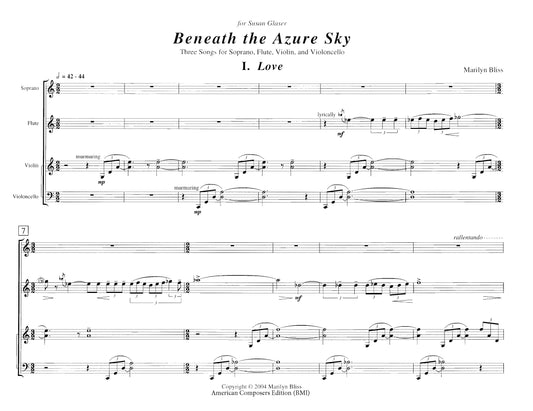
    Composed in 2004, "Beneath the Azure Sky" is a setting in three movements of poetry by Afghan women. For many reasons, this poetry is deliberately anonymous and not written down: most Afghan women are illiterate, having been denied education by the society they live in. The poetry is often also startlingly intimate, revealing inner thoughts that would be deadly to express publicly; the poems are often addressed to lovers who would be killed if they were found out. The form of the poetry is called the landay, a very brief poetic form consisting of two verse lines of nine and thirteen syllables. I have chosen several different landays to knit together a narrative: the first movement is entitled Love, the second Separation, and the third Exile. The poetry became available to us through the courageous efforts of Afghan national poet Sayd Bahodine Majrouh, who surreptitiously collected them in oral interviews in Afghan refugee camps. Founder of the Afghan Information Center after the Soviet invasion of Afghanistan, he was assassinated in Peshawar, Pakistan, in 1988. These poems were translated from Pashtun into French by Majrouh, and from French into English by the distinguished translator Marjolijn de Jager. Although my musical language is not folklike, I have attempted to create in this piece a clarity of expression to allow the words and emotions to communicate freely from performers to audience.

    Publisher: 
    ACA
  • Bestiary

    Composer: 
    Marilyn Bliss
    Instrumentation freestyle: 
    solo violin
    Year Authored: 
    1989
    Duration (min): 
    12:
    Movements-Titles: 
    4

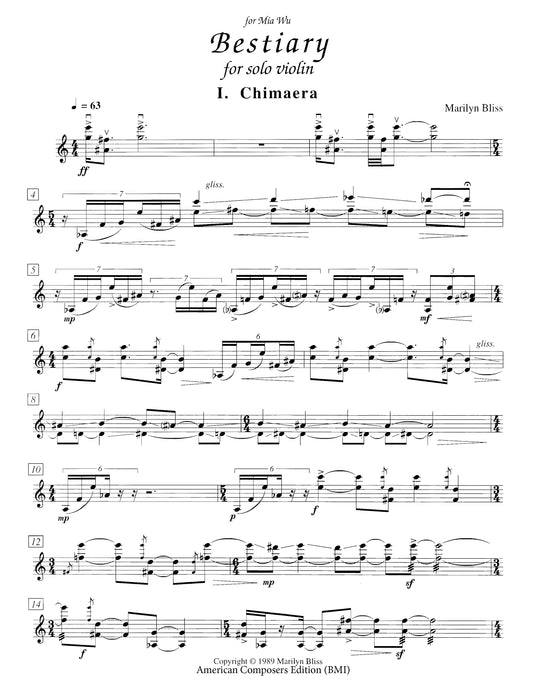
    Bestiary, for violin solo, is a suite of four movements, each depicting a mythological beast. The first movement, "Chimæra," like its namesake, is composed of several broadly diverse elements that improbably are brought together to make a whole. The second movement, "Minotaur (the Maze)," depicts the Cretan labyrinth that housed the Minotaur through an intricate stream of notes that doubles back on itself, encounters walls, finds the maze's center, and retraces its path out to safety. The "Sphinx" offers its question three times: first, to a very nervous traveler who answers incorrectly and is devoured; next, to a traveler who answers with bravado -- but still incorrectly -- and is also eaten; and, finally, to Oedipus, who answers with somber assurance, destroying the Sphinx. The final movement, "Pegasus," is a galloping romp through the sky by the beautiful winged white horse.

    Publisher: 
    ACA

    Instruments

  • Blue Dawn

    Composer: 
    Marilyn Bliss

    Instrument Write-In

    Instrumentation freestyle: 
    native american flute, vlc
    Year Authored: 
    1998
    Publisher: 
    ACA

    Ensemble Type

    Instruments

  • Celestial Greetings

    Composer: 
    Marilyn Bliss
    Scoring, for orchestra pieces: 
    Soprano and Piano
    Year Authored: 
    1983
    Duration (min): 
    8
    Alternate Title: 
    Celestial Greetings
    Movements-Titles: 
    1
    Text Source/Author: 
    Scottish Gaelic poetry, in English translation

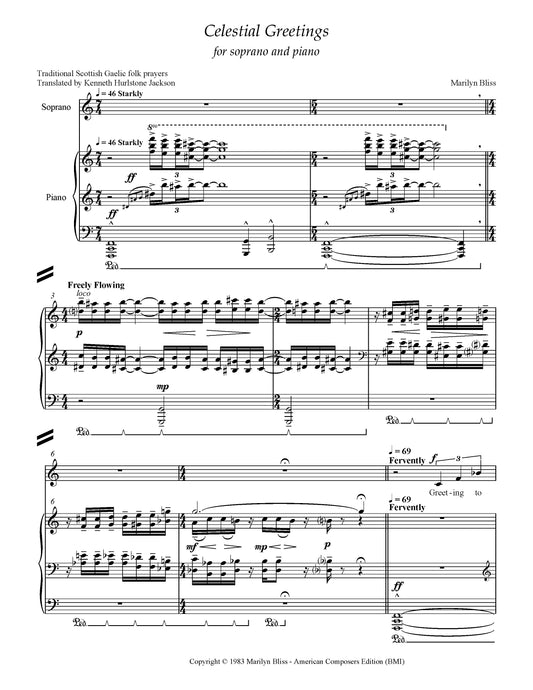
    Celestial Greetings, written in 1983, is a setting of three traditional Scottish-Gaelic folk prayers to the celestial bodies. Rather than creating three separate songs, I have treated the poems as variations-upon-a-theme, the passing of a day.

    Publisher: 
    ACA

    Ensemble Type

    Instruments

  • Chameleon

    Composer: 
    Marilyn Bliss
    Instrumentation freestyle: 
    fl, vlc, pf
    Year Authored: 
    1981
    Duration (min): 
    9:
    Movements-Titles: 
    1

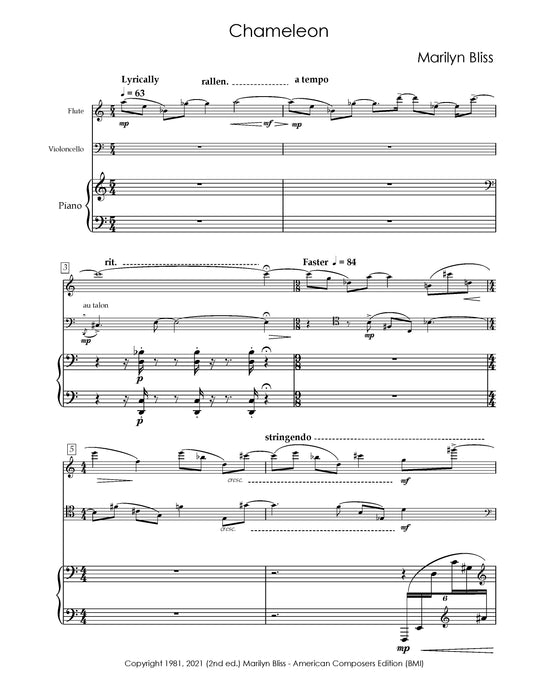
    Chameleon, for flute, 'cello, and piano, was written in 1980-81 and takes as its inspiration the remarkable adaptability of the chameleon to its surroundings. Its analogue in this piece is a motive, A-E-Bb-Gb, that is continuously present in various guises throughout the many changing moods of the trio.

    Publisher: 
    ACA

    Ensemble Type

  • Encounter

    Composer: 
    Marilyn Bliss
    Instrumentation freestyle: 
    fl
    Year Authored: 
    1975
    Duration (min): 
    3:
    Movements-Titles: 
    1

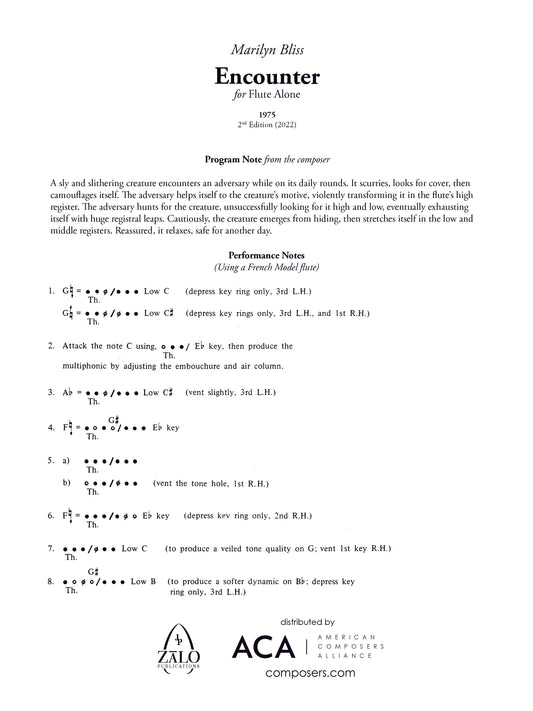
    A short dramatic piece for flute, using a few multiphonics.

    Publisher: 
    ACA

    Instruments

  • Evocations

    Composer: 
    Marilyn Bliss
    Instrumentation freestyle: 
    Tuba
    Year Authored: 
    1981
    Duration (min): 
    9:
    Movements-Titles: 
    4

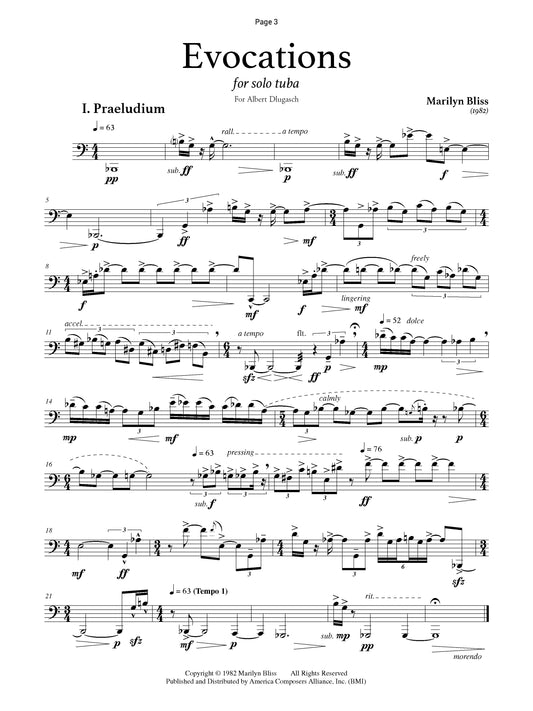
    Evocations for solo tuba was written in 1982 and is dedicated to Albert Dlugasch, who premiered the work. The four movements explore the broad range of sound, timbre, register, and emotion obtainable on this too-often misunderstood and neglected instrument. The first movement, Præludium, opens with brassy, fanfare-like material, contrasting with a second theme of mellow lyricism. It is followed by the black humor of Burlesque, and the sweet melancholy of Arioso. The final movement, Largo-Finale, begins slowly in the tuba's lowest register, then adds a second line in contrary motion as the performer hums into the instrument. The mood is interrupted by a triplet figure introducing the finale, an intricate, whirlwind movement of virtuosic difficulty.

    Publisher: 
    ACA

    Instruments

  • Fantasies

    Composer: 
    Marilyn Bliss
    Instrumentation freestyle: 
    pf
    Year Authored: 
    1977
    Duration (min): 
    11:
    Movements-Titles: 
    3

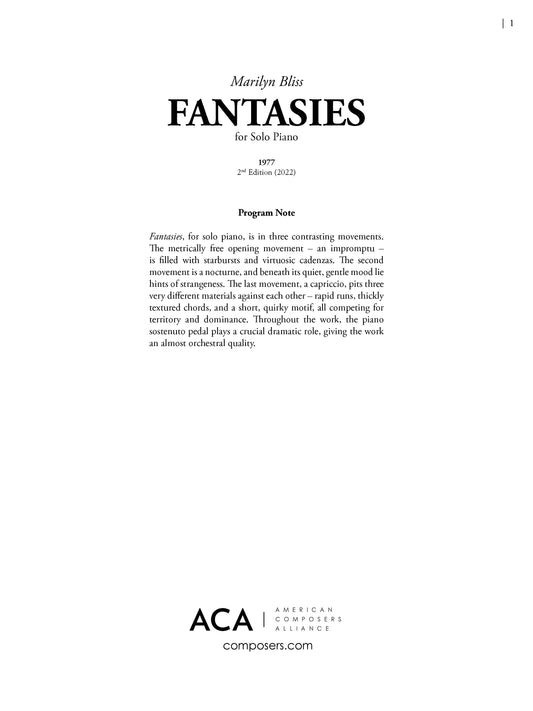
    Fantasies for solo piano, written in 1977, is in three contrasting movements. The dramatic first movement is metrically free, with virtuosic cadenzas. The second is a night piece, and beneath its gentle mood lie hints of strangeness. The third movement pits three very different materials against each other—rapid runs, thickly textured chords, and a short, quirky motif, which compete for territory. "Fantasies" was performed at the Moscow Autumn Music Festival and recorded by Elena Ivanina on North-South Recordings 1017.

    Publisher: 
    ACA

    Ensemble Type

    Instruments

  • Flocks

    Composer: 
    Marilyn Bliss
    Instrumentation freestyle: 
    piccolo and alto flute
    Year Authored: 
    1988
    Duration (min): 
    8:
    Movements-Titles: 
    1

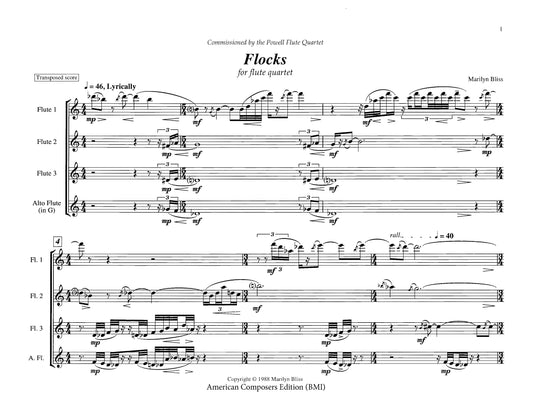
    Flocks, for flute quartet, was inspired by the annual migration of flocks of birds from their summer home in the North to their winter home in the South. The piece is loosely programmatic, beginning with the first restless urges of some, then even the most reluctant birds, to leave their northern home, through their joyful flight south -- often flying in parallel or similar motion --, to the sighting of their southern home, and finally the quiet of sleep after the long journey.

    Publisher: 
    ACA

    Ensemble Type

  • Huatzu Hill

    Composer: 
    Marilyn Bliss
    Instrumentation freestyle: 
    Soprano, Flute/Piccolo, Clarinet/Eb Clarinet, Horn, Strings
    Year Authored: 
    1979
    Duration (min): 
    12:
    Movements-Titles: 
    4
    Text Source/Author: 
    Poems by Wang Wei (8th-century Chinese, in English translation)

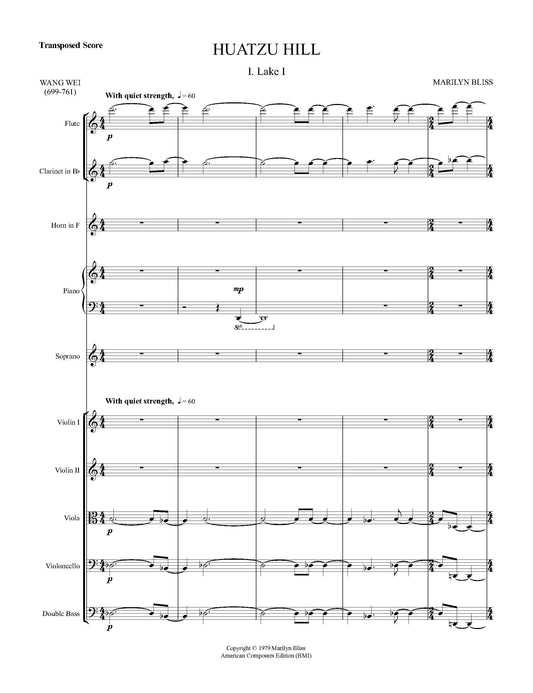
    Huatzu Hill for soprano and chamber orchestra is a setting of four poems by Wang Wei, an 8th-century Chinese poet, as translated into English by G.W. Robinson. Three of the four songs depict landscapes near Wang's country retreat in the Wang River valley. The second song is a bittersweet farewell to a beloved friend. Huatzu Hill is scored for chamber orchestra and soprano soloist. It was premiered at the Composers Conference in Vermont and has been performed by the New England Philharmonic and the Berkshire Symphony. "A series of rich landscapes - the colors sharp, the feeling powerfully concentrated, the expression concise..." Boston Globe.
    Publisher: 
    ACA

    Ensemble Type

  • It Was the Wind

    Composer: 
    Marilyn Bliss
    Instrumentation freestyle: 
    Soprano and Flute or Native American Flute
    Year Authored: 
    1995
    Duration (min): 
    3
    Movements-Titles: 
    1
    Text Source/Author: 
    Navajo poem

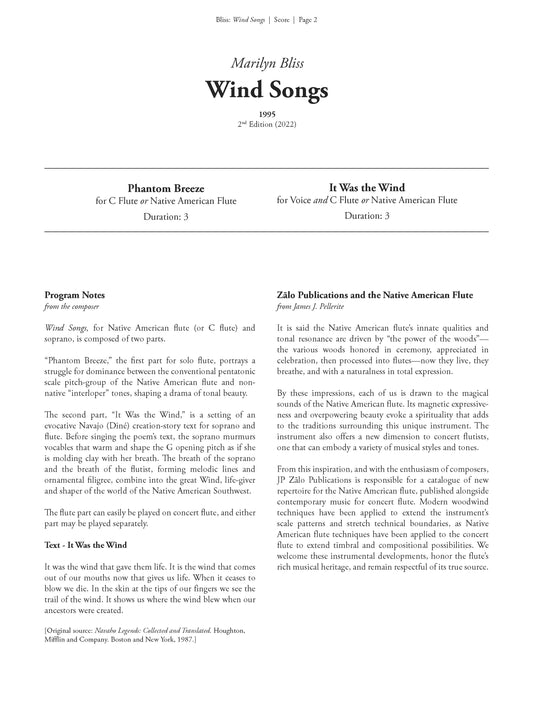
    Part of the set of 'Wind Songs', along with 'Phantom Breeze', 'It Was the Wind' is a setting of a Navajo text for Native American flute and soprano (it may also be played by concert flute).

    Publisher: 
    ACA

    Ensemble Type

  • Lament

    Composer: 
    Marilyn Bliss
    Instrumentation freestyle: 
    Alto Flute
    Year Authored: 
    1984
    Duration (min): 
    3:
    Movements-Titles: 
    1

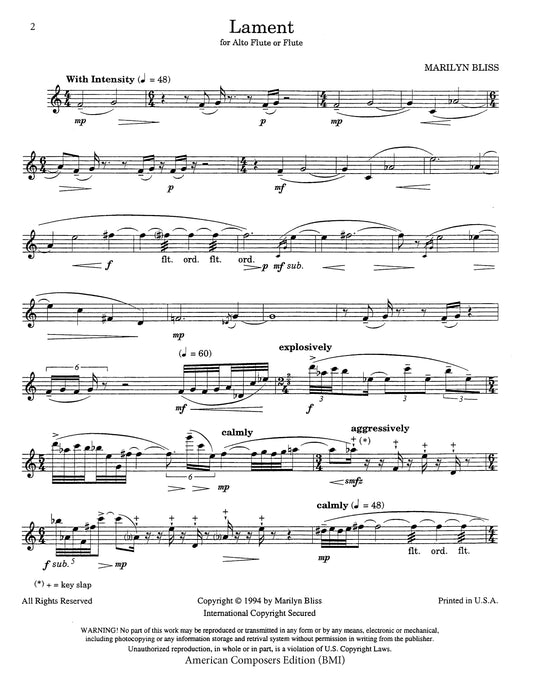
    The genesis of "Lament," written in 1984, was a recollection of an early Martha Graham dance entitled Lamentation, in which the dancer sits on the floor and stretches her elastic jersey costume about her body with her feet and hands. I was impressed not only by the sad, isolated, wrenching mood of the dance, but also by its focus and its exploration of a single idea. Concurrent with this memory was a desire to write a new piece for solo flute, and a realization of the great beauty of sound that exists in the alto flute. Lament has been choreographed by Ruth Meyer, former principal, American Ballet Theater. Lament is recorded on "Airs to Charm a Lizard," Katherine Kleitz, flutist (New England Compact Disc, B0007MVHWG). Available at Amazon.com.

    Publisher: 
    ACA

    Instruments

  • Murali

    Composer: 
    Marilyn Bliss
    Instrumentation freestyle: 
    fl
    Year Authored: 
    2003
    Duration (min): 
    3:
    Movements-Titles: 
    1
    First Performance: 
    Nina Assimakopoulos, 2004

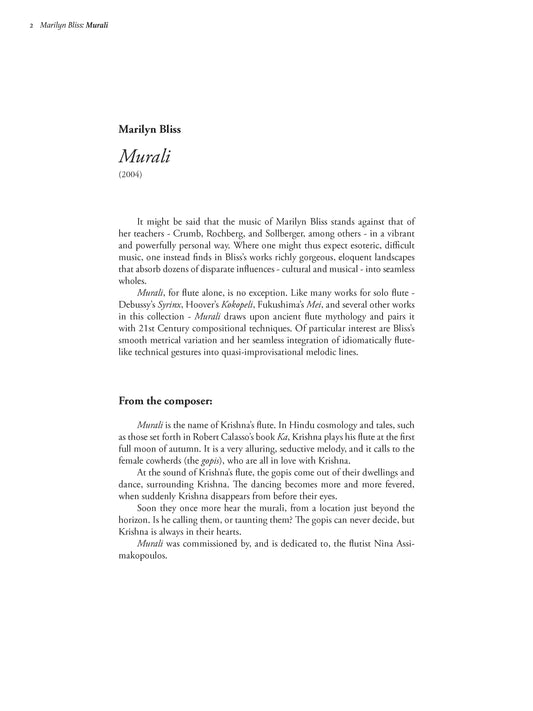
    When asked by Nina Assimakopoulos to write a short piece for flute inspired by literature, my attention turned to the many depictions of Krishna playing the flute that one can see by strolling through the streets of my multicultural neighborhood of Jackson Heights in Queens, New York. Murali is the name of Krishna’s flute. In Hindu cosmology and tales, such as those set forth in Robert Calasso’s book Ka, Krishna plays his flute at the first full moon of autumn. It is a very alluring, seductive melody, and it calls to the female cowherds (the gopis), who are all in love with Krishna. At the sound of Krishna’s flute, they come out of their dwellings and dance, surrounding Krishna. The dancing becomes more and more fevered, when suddenly Krishna disappears before their eyes. Soon they once more hear the murali, from a location just beyond the horizon. Is he calling them, or taunting them? The gopis can never decide, but Krishna is always in their hearts. This work is recorded on Capstone Records CPS-8759.

    Publisher: 
    ACA

    Instruments

  • Phantom Breeze

    Composer: 
    Marilyn Bliss
    Instrumentation freestyle: 
    Flute or Native American Flute
    Year Authored: 
    1993
    Duration (min): 
    3:
    Movements-Titles: 
    1

    Part of the set of 'Wind Songs', along with 'It Was the Wind', this solo movement shows the struggle for dominance between conventional note pattern of the Native flute's scale and the interlopers (neighboring tones), shaping a drama of tonal beauty.

    Publisher: 
    ACA

    Instruments

  • Rima

    Composer: 
    Marilyn Bliss
    Instrumentation freestyle: 
    Piccolo, Piano
    Year Authored: 
    1989
    Duration (min): 
    11:
    Movements-Titles: 
    1
    First Performance: 
    National Flute Association Convention, August 1989

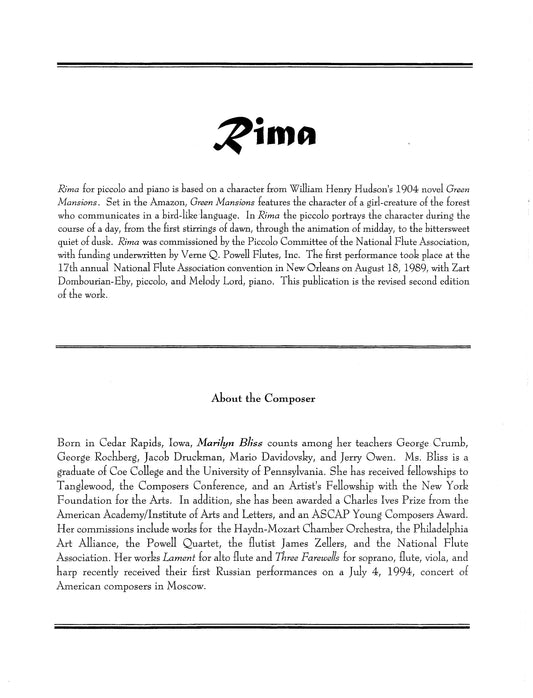
    "Rima" for piccolo and piano is based on a character from William Henry Hudson's 1904 novel Green Mansions. Set in the Amazon, Green Mansions features the character of a girl-creature of the forest who communicates in a bird-like language. In Rima the piccolo portrays the character during the course of a day, from the first stirrings of dawn, through the animation of midday, to the bittersweet quiet of dusk. "Rima" was commissioned and premiered by the Piccolo Committee of the National Flute Association. It is used as a standard competition piece by the NFA. "...a significant contribution to the literature..." Flutist Quarterly. Recorded by Susan Glaser on Koch International Classics 3-7396-2-H1 and by Nicola Mazzanti on his self-produced CD "A Night with the Piccolo" available from CDBaby.com and from the artist.

    Publisher: 
    ACA

    Ensemble Type

    Instruments

  • Shadowflowers

    Composer: 
    Marilyn Bliss
    Instrumentation freestyle: 
    Soprano, Flute, Alto Flute/Piccolo, Oboe/English Horn, Violin, Cello, Harp, Percussion
    Year Authored: 
    1978
    Duration (min): 
    12:
    Movements-Titles: 
    1
    Text Source/Author: 
    French text by Stephane Mallarme and Guillaume Apollinaire, German text by Stefan George

    Shadowflowers is an unstaged psychodrama for soprano, tenor, and chamber ensemble. The text, assembled from the poetry of Stefan George, Stéphane Mallarmé, and Guillaume Apollinaire, concerns two beautiful, yet repulsive, artificial worlds. George's poem, from "Algabal," used in its entirety, presents to the reader an underground garden, beautiful but completely artificial, black, and dead. In Mallarmé's "Hérodiade," excerpted here, the reader encounters a beautiful virgin, living in a world of white and jewels, allowing nothing to touch her. The poems are sung together, commenting on each other while carrying on their own dramatic senses. Another factor in choosing the text was the constant recurrence of the words "shadow" and "flower" in all excerpts, which contributes to the black/white, dark/bright imagery. The music is in two unbroken sections, following the shape of the text.

    Publisher: 
    ACA
  • Spirit Dance

    Composer: 
    Marilyn Bliss
    Instrumentation freestyle: 
    Flute or Native American Flute and Maracas
    Year Authored: 
    1995
    Duration (min): 
    4:
    Movements-Titles: 
    1

    Inspired by Native American shaman ceremonies, this piece for Native American flute and maracas features bending tones and a steadily building accelerando to an ecstatic ending. The flute part may also be played on concert flute, or adapted for shakuhachi.

    Publisher: 
    ACA

    Ensemble Type

    Instruments

  • Three Farewells

    Composer: 
    Marilyn Bliss
    Instrumentation freestyle: 
    Soprano, Flute, Viola, Harp
    Year Authored: 
    1984
    Duration (min): 
    11:
    Movements-Titles: 
    3
    Text Source/Author: 
    Poetry from the Greek Anthology, in English translation

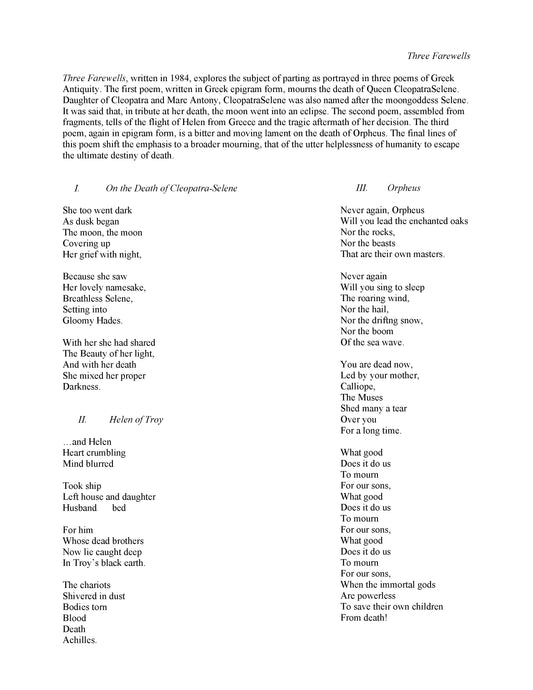
    Three Farewells, written in 1984, explores the subject of parting as portrayed in three poems of Greek Antiquity. The first poem, written in Greek epigram form, mourns the death of Queen Cleopatra-Selene. Daughter of Cleopatra and Marc Antony, Cleopatra-Selene was also named after the moon-goddess Selene. It was said that, in tribute at her death, the moon went into an eclipse. The second poem, assembled from fragments, tells of the flight of Helen from Greece and the tragic aftermath of her decision. The third poem, again in epigram form, is a bitter and moving lament on the death of Orpheus. The final lines of this poem shift the emphasis to a broader mourning, that of the utter helplessness of humanity to escape the ultimate destiny of death.

    Publisher: 
    ACA
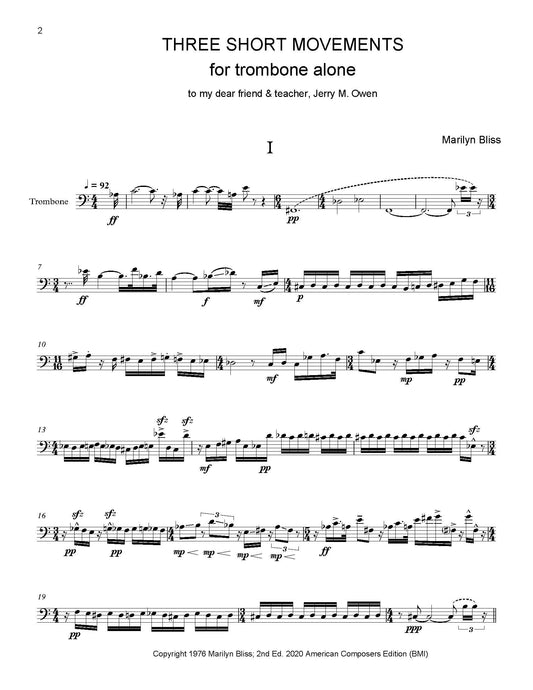
  • Three Short Movements

    Composer: 
    Marilyn Bliss
    Instrumentation freestyle: 
    Trombone
    Year Authored: 
    1976
    Duration (min): 
    8:
    Movements-Titles: 
    3
    Publisher: 
    ACA

    Instruments

  • Trio

    Composer: 
    Marilyn Bliss
    Instrumentation freestyle: 
    Violin, Cello, and Piano
    Duration (min): 
    20:
    Movements-Titles: 
    3

    The Trio for violin, 'cello, and piano uses the framework of classic three-movement form (sonata-allegro, theme-and-variations, rondo) as its point of departure. These forms interact with the musical language, which sometimes upholds but often subverts them. Themes may intertwine, disintegrate, or reappear in a different movement, constantly challenging their subordination to form, while simultaneously deriving their meaning from it.

    Publisher: 
    ACA

    Ensemble Type

    Instruments

  • Veils

    Composer: 
    Marilyn Bliss
    Scoring, for orchestra pieces: 
    2 Flutes, 2 Oboes, 2 Bassoons, 2 Horns, Strings
    Year Authored: 
    1986
    Duration (min): 
    10:
    Movements-Titles: 
    1
    First Performance: 
    Haydn-Mozart Chamber Orchestra, 1986

    Veils was inspired by a group of paintings by the great American abstract painter Morris Louis. For these paintings Louis devised a technique of staining the canvas, allowing the colors both to mingle and to keep separate their identities. The results are paintings of delicate, veil-like translucence, which, combined with their large scale, entice the observer to enter. In my orchestra piece, I have translated some of these techniques and images into music. Winds are in pairs and usually appear together, purifying their color; melodic lines in the strings are seamlessly passed from section to section; quasi-canonic passages create increasingly dense, but still translucent, "veils" of sound. Throughout the piece, the principal oboe is the protagonist. It sometimes seems to stand aside, observing, reflecting, only to be swept back into the flow of the piece. Thus the oboe-observer sees the piece from within, at last fulfilling the desire of the observer in the gallery.

    Publisher: 
    ACA

    Ensemble Type